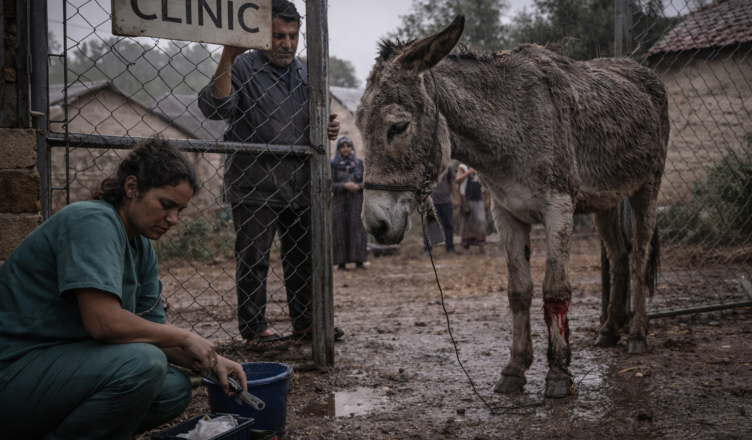
Everyone in the village knew the sound of Kito’s hooves.
He was an old donkey—gray and narrow-hipped, with a white blaze on his forehead and ears that flopped like tired flags. Most mornings he hauled water jugs from the well, patient as sunrise. Kids ran alongside him. Dogs barked at his heels. Kito never kicked.
Then one morning, he didn’t show up.
By noon, people noticed. By evening, they started asking. The owner, a quiet man named Ibrahim, searched the usual places—market road, the fig trees, the shortcut behind the school. No Kito.
That night, rain fell hard enough to flatten the dust into mud.
And in the morning, Kito appeared at the clinic gate.
Not inside the yard.
At the gate—standing straight, head low, like a man waiting to be admitted.
He didn’t bray. He didn’t pull at the latch. He just stood there in the drizzle, water dripping from his ears, breathing slow.
The vet, Dr. Rania, saw him through the window and knew instantly something was wrong.
Animals don’t come to a clinic by accident.
She stepped outside with a calm voice and open hands. “Kito… hey, old boy.”
Kito didn’t move forward.
He couldn’t.
When he shifted his weight, his front leg trembled, and the hoof didn’t land flat. He was trying to hold himself together with stiffness and pride, but pain leaked through the cracks. Mud clung to his knees. His coat was scraped raw along one side, like he’d gone down hard on gravel.
And then Dr. Rania saw the blood.
A dark line ran down his fetlock, thin but steady, disappearing into the mud.
She knelt and touched his leg gently.
Kito flinched—not away, but inward—like the pain was so deep his body didn’t know where to put it.
She followed the blood trail up and found the cause.
Wire.
A thin, twisted strand of fencing wire had wrapped around his lower leg and tightened as he walked, cutting into skin with every step. It had sunk deep enough that the hair was worn away and the flesh was swollen over parts of it.
He must have been caught in it all night.
Dragging it.
Panicking.
Falling.
Then, at some point—alone in the dark—he had stood up, found the road, and come to the only place he knew that smelled like help.
The clinic staff gathered quietly, voices low. Someone fetched cutters. Someone brought a bucket of warm water. Dr. Rania told them to move slowly.
Donkeys don’t scream like horses. They don’t collapse dramatically. They just endure until endurance runs out.
Kito stood, eyes half-lidded, breathing through his nose, letting them work.
As the cutters bit into the wire, the metal resisted—tight, embedded, stubborn. Dr. Rania slipped a finger under a loop and felt it bite her glove.
“Easy,” she whispered, mostly to herself.
Finally, the wire snapped loose.
Kito’s leg jerked, then steadied. His breath came out in a long exhale that sounded like a sigh.
But when they washed the wound, the truth showed itself.
The cut was deep. Infected. The leg was hot and swollen, and the hoof below was colder than it should be. If circulation didn’t return, he could lose the foot. If the infection climbed, he could lose the leg.
Or worse.
Ibrahim arrived at the gate while they were cleaning him, face tight with fear.
“Kito,” he breathed, kneeling beside him. “My boy… where were you?”
Kito turned his head slightly and rested his muzzle against Ibrahim’s shoulder.
Not affection the way a dog gives it.
Something heavier.
Trust.
Dr. Rania explained the situation plainly. Antibiotics, daily cleaning, bandaging, rest. Weeks of it. Money.
Ibrahim stared at the ground.
“I don’t have—” he started, voice breaking.
Dr. Rania looked at the staff. Then at the neighbors who had gathered at the fence.
There are moments in small communities when everyone understands the same thing at once: this animal has carried more than water. It has carried people’s lives.
A woman stepped forward and set a few bills on the clinic table.
Then another person. Then another. Coins. Notes. Quiet offerings without speeches.
Ibrahim’s eyes filled. He covered his mouth with his hand and nodded over and over, unable to speak.
Kito stood there through it all, rain dripping off his ears, as if he knew the decision had been made in his favor.
The first night was hard.
Pain makes animals restless. Infection makes them weak. Kito tried to lie down and couldn’t find a position that didn’t hurt. He shifted in the stall, hoof scraping straw, breathing fast.
Ibrahim slept outside the stall door on a blanket, refusing to leave.
Every time Kito moved, Ibrahim whispered, “I’m here. I’m here.”
By the third day, the swelling began to ease. By the fifth, the hoof felt warmer. By the seventh, Kito could put weight on the leg without trembling.
He still limped.
But he stood.
And for an old donkey, standing is victory.
Weeks later, when Kito walked back through the village, bandage finally gone, the kids ran beside him like they always had. Dogs barked. The market road hummed with normal life.
But something had changed.
People watched him with a different kind of respect now, like they’d finally understood what he’d done.
Because Kito hadn’t just survived wire and mud and night.
He had found his way to help.
He had chosen the clinic gate.
And he had waited there—quietly, stubbornly—until someone opened it.