The hardware store opened before sunrise.
A cold place—concrete floors, fluorescent lights, the smell of fertilizer and metal. At the back, the delivery door stayed cracked for the forklift, letting in thin air and early fog.
That was how the owl got inside.
No one saw it fly in. They only heard the chaos when it tried to fly out—wings slapping the ceiling beams, a thud against a shelf, a crash of plastic buckets tipping over like dominoes.
Then silence.
When the manager found it, the owl was on the floor behind the garden aisle, crouched low and breathing hard. Its feathers were puffed up, one wing held slightly away from the body like it didn’t want to fold. Its eyes were huge, golden, and furious—not aggressive, just trapped.
But the worst part was what it was trapped in.
A wire basket.
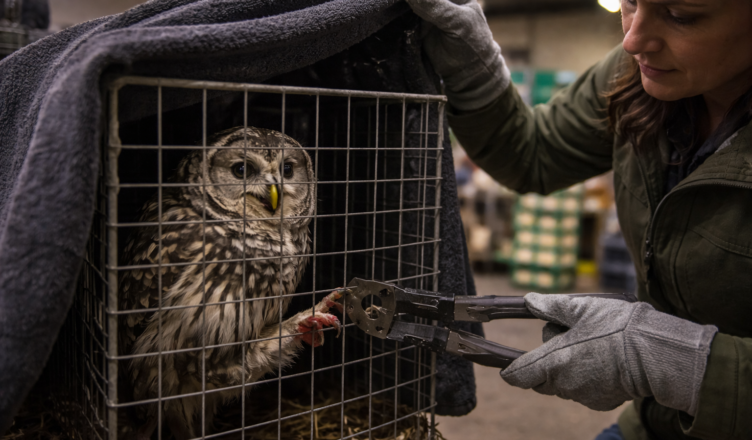
One of those tall rolling baskets used for bulk deliveries—metal grid sides and a heavy base. The owl had fallen into it during the panic, and now one talon was hooked through the mesh, twisted at the wrong angle. Every time it tried to pull free, the talon caught deeper. The owl snapped its beak and flared its wings, beating the wire in violent bursts that only tightened the trap.
The manager swore softly.
Customers had started gathering, phones out, whispering like it was a show. The owl’s chest rose and fell fast, each breath sharper. Stress was already doing damage. Birds can die from panic as easily as injury.
“Everybody back,” the manager barked. “Now.”
He killed the aisle lights, leaving only dim spill from the front of the store. Then he called wildlife rescue.
While they waited, the manager did the one smart thing he could think of: he made the world smaller and darker.
He grabbed a tarp from the shelf and draped it over the basket.
Instantly, the owl’s thrashing slowed.
Not because it was calm—because darkness turns panic into stillness. It’s the closest thing to mercy you can offer a wild animal in a bright, loud human box.
The rescuer arrived ten minutes later, carrying thick gloves, cutters, and a towel. She didn’t rush to lift the tarp. She listened first. Watched the basket shift slightly with each breath.
“Okay,” she murmured. “Okay, I’m here.”
She reached under the tarp carefully, found the trapped talon by feel, and froze.
“It’s through deep,” she said quietly.
The manager swallowed. “Can you get it out?”
“Not by pulling,” she replied. “If we pull, we break it.”
She slid bolt cutters through the wire mesh and started cutting the basket itself—snip by snip—creating space around the talon rather than forcing the talon to move. Each cut rang softly in the metal, and every ring made the owl flinch. But it stayed mostly still under the tarp, trusting the darkness more than it trusted people.
When the final cut freed the last strand of wire, the rescuer eased the tarp up just enough to check.
The owl’s talon came free with a small, sickening slip.
The bird didn’t fly.
It tried to stand and stumbled, putting no weight on that foot. The talon was bleeding, swollen, and the joint looked strained. Not an easy fix in the wild. An owl needs perfect feet to hunt. Perfect feet to live.
The rescuer wrapped it in a towel smoothly, tucking wings in, covering the eyes again, and carried it out like something fragile and furious.
The manager watched her go, jaw tight. “Is it going to make it?”
The rescuer looked back. “If it eats. If the foot heals. If it doesn’t give up.”
At the rehab center, the owl stayed silent for a day.
Then it refused food.
Then it took one bite.
Then it refused again.
Recovery wasn’t a straight line. It was a battle of inches—anti-inflammatories, careful cleaning, a dim enclosure where stress wouldn’t finish what wire started.
On the fifth night, the owl finally ate properly—tearing into food with a sudden, vicious focus that made the staff grin like proud parents.
On the tenth day, it began to grip again.
Weakly at first. Then better.
And one evening, when the rescuer opened the flight cage and stepped back, the owl launched.
Wings wide, air catching under feathers like a remembered skill, it crossed the cage in a clean glide and landed on a perch without slipping.
The foot held.
Release day came at dusk.
They brought it to the edge of a wooded field behind the rehab center, where the sky was turning purple and the world was quiet again. The manager from the hardware store came too, standing with his hands in his pockets like he didn’t know what to do with them.
The rescuer opened the crate.
The owl didn’t rush out.
It paused at the threshold, head turning, listening to the dark the way owls do—like they can hear the planet breathing.
Then it stepped out, lifted its healed foot, tested the grip of the ground, and spread its wings.
For a second, it looked straight at them.
Not grateful.
Not affectionate.
Just awake.
Then it lifted into the evening like it had never been trapped, never been dragged down by wire and panic and bright human light.
It vanished between the trees.
The manager exhaled.
Because sometimes rescue isn’t dramatic.
Sometimes it’s cutting a cage apart piece by piece, so the thing inside can leave without losing what it needs to live.