It was supposed to be simple.
A newborn calf in the early morning—steam rising off the barn roof, the soft chaos of feeding time, men in muddy boots moving like they’d done this a thousand times. The calf stood in the corner of the pen, legs too thin, ears too big, blinking slowly like the world was too bright.
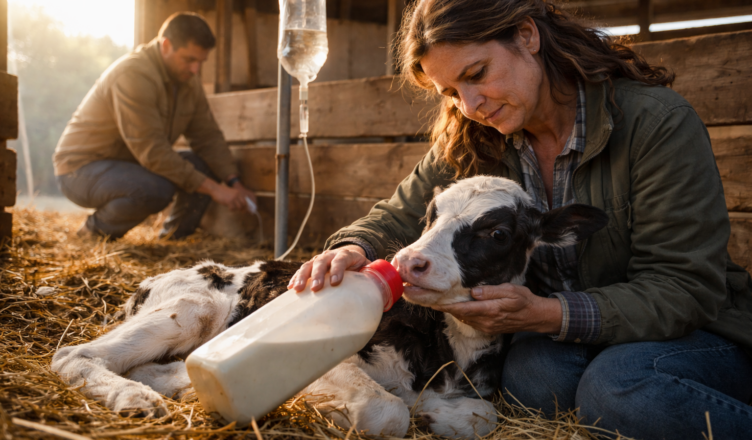
The farmer’s wife, Elena, held the bottle out.
The calf turned its head away.
Not shy.
Not stubborn.
The kind of refusal that makes your stomach tighten because you’ve seen it before.
“Elena,” the farmer called from the aisle, “he’ll take it when he’s hungry.”
But Elena didn’t move.
She watched the calf’s mouth—how it opened slightly and then closed again, how the tongue didn’t reach the nipple properly. She watched the way he swallowed nothing, then flinched as if swallowing hurt.
The calf’s tail didn’t flick. His eyes didn’t follow movement. He just stood there, breathing too fast, as if each breath was work.
Elena knelt in the straw and spoke softly. “Hey, baby. What happened to you?”
The calf leaned into her hand—just a fraction—then shuddered.
When she touched under his jaw, she felt heat. Swelling. A hard lump that didn’t belong.
She called the vet.
The vet arrived quickly and didn’t waste time with optimism. She opened the calf’s mouth gently, and the smell told her the rest.
Infection.
The calf’s tongue was injured—torn and swollen. The back of his mouth was raw. The kind of injury that happens when something sharp catches a newborn, or when a panicked cow steps wrong in a crowded pen, or when a mouth gets crushed for half a second and that half-second becomes a lifetime.
The calf wasn’t refusing to drink because he didn’t want milk.
He was refusing because drinking felt like fire.
“If he doesn’t get fluids today,” the vet said, voice tight, “he won’t make it.”
The farmer swore quietly and looked away.
Elena didn’t.
She watched the calf’s knees tremble, the way his head dipped and rose again like he was fighting sleep. Newborns don’t have time. They’re either fed or they’re gone.
The vet set up an IV line.
The calf didn’t fight. That was another bad sign—animals this young usually kick and panic. This one just stood there and let it happen, eyes half-lidded, body already too tired to argue for itself.
They gave him pain relief. Antibiotics. Warm electrolytes.
Then Elena did something the vet didn’t ask for.
She sat down in the straw, pulled the calf’s head into her lap, and held him the way you hold a child with a fever—steady, close, warm enough to remind the body it’s not alone.
The calf’s breathing slowed slightly.
A few minutes later, he tried to drink again.
Not from the bottle. Not yet.
He just moved his mouth like he remembered how, tongue weak and swollen, trying to find the motion that used to be automatic.
Elena’s eyes filled. “That’s it,” she whispered. “That’s it. Don’t quit.”
For three days, it was like that.
The calf on IVs, Elena with warm compresses, the vet coming back to flush the infection and check the swelling. Every feeding was a battle between hunger and pain. Some attempts ended in trembling refusal. Some ended in a few precious swallows.
The farmer stopped telling Elena to “let nature handle it.”
Because nature was trying to handle it.
It was trying to take the calf.
On the fourth morning, Elena walked into the barn and found the calf standing on his own, head lifted, eyes brighter. The IV had been removed the day before, and he’d made it through the night on his own strength.
Elena held the bottle out again.
The calf hesitated.
Then, with a shaky determination that didn’t belong to something so small, he latched on.
He drank.
Slowly at first—tiny pulls, careful swallows—then faster as his body realized the pain had backed off enough to allow life in.
Milk dribbled down his chin. Elena laughed through tears. The farmer leaned against the stall door and let out a breath he’d been holding for days, staring like he couldn’t believe what he was seeing.
The calf finished and lifted his head, blinking at Elena with sleepy satisfaction.
Then he did the smallest thing that broke her completely:
He nudged her hand with his nose.
Not hungry.
Not demanding.
Just… touching her the way animals touch the ones who saved them.
A week later, the calf ran in the pen for the first time.
Wobbly, awkward, legs too long for his body, but running—little hops and kicks like joy was a language he’d only just learned.
Elena stood by the fence and watched, hand on her chest.
Because she would never forget the first day.
The way the calf wouldn’t drink.
The way everyone thought it was nothing.
The way pain can be silent and still kill you.
And the way a newborn, with every reason to stop trying, still chose—one swallow at a time—to stay.