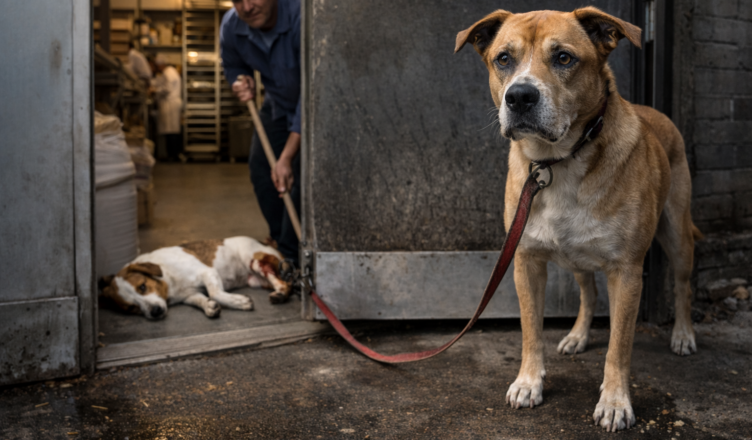
He was already there when the bakery lights came on.
A big mixed-breed—tan coat, white chest, one ear torn at the tip—standing perfectly still beside the back door like he’d been assigned to it. Not pacing. Not begging. Just standing, head slightly lowered, eyes fixed on the crack beneath the door.
When the first worker arrived, she clapped her hands to shoo him away.
He didn’t move.
She tried again, louder. “Go on! Shoo!”
The dog flinched, but he stayed. Like sitting down would break something. Like leaving would.
By the time the morning rush started, people were stepping around him. Some tossed crumbs. Some rolled their eyes. A kid reached out to pet him and the dog leaned into the touch for one second—then snapped his attention back to the door.
It wasn’t stubbornness.
It was waiting.
The manager, tired of complaints, finally grabbed a broom and went outside to chase him off properly. Up close, he saw what everyone else missed.
The dog’s legs were trembling.
Not from fear. From effort.
His belly was tight and drawn, like he was holding something in. His breathing came fast through his nose, and every few seconds he swallowed hard and made a faint, broken whine that sounded like it hurt to keep inside.
The manager lowered the broom.
He crouched slowly. “Hey… what’s wrong with you?”
The dog’s eyes flicked to him—pleading, urgent—then back to the door. And then, as if he’d finally been given permission to show it, he turned his head slightly.
A thin leash was looped around his neck.
The other end disappeared under the door.
The manager’s stomach dropped.
He yanked the door open.
Inside the narrow storage hallway—between flour sacks and stacked trays—a small dog lay on her side, leash still clipped to her collar. She was breathing, but shallowly. Her gums were pale. One back leg was twisted under her body, and her fur was wet with blood near the hip.
The manager swore under his breath.
The big dog—still standing outside—pulled forward hard, trying to get in, but the leash stopped him like a hand. He made a strangled sound, half bark, half cry, and his whole body shook.
He had been holding himself up all morning because if he sat, the leash would slacken… and he might lose contact.
He might stop feeling her.
He might stop being tethered to the only thing he cared about.
The manager dropped to his knees beside the injured dog and checked her quickly. “Hey, hey, hey… stay with me.”
Then he yelled for someone to call a vet.
A worker grabbed towels. Another ran for the phone. The store filled with the sudden kind of chaos that makes you realize how fragile “normal” is.
The manager unclipped the leash and carried the injured dog out carefully, wrapped in a towel.
The big dog followed so close he nearly tripped everyone, nose pressed to her side, whining softly, eyes glassy with panic. He kept trying to lick her face, like he was trying to remind her how to breathe.
At the emergency clinic, the diagnosis hit hard.
Hit by a car. Crawled into the storage hallway for shelter. Internal bruising. A deep wound near the hip. Surgery needed. Pain meds. Fluids. Time.
The vet looked at the manager. “Did you see any owner?”
The manager shook his head. “No. Just him.” He nodded toward the big dog, who was sitting—finally sitting—on the clinic floor, staring at the treatment room door like it was the back door of the bakery all over again.
The vet’s expression softened. “He brought her here.”
Hours later, the injured dog came out of surgery alive. Still weak. Still bandaged. But breathing better.
They placed her in a recovery kennel with blankets and heat.
The big dog was allowed in for one minute.
He walked in slowly, like he was afraid this was a trick. Then he pressed his forehead against the kennel bars and let out a sound that wasn’t a bark.
It was relief so deep it almost sounded like grief.
The little dog’s eyes opened halfway. She lifted her head an inch, sniffed, and then her tail—barely—moved.
The big dog’s whole body sagged.
He lay down for the first time all day, chin on his paws, eyes never leaving her.
The manager watched from the doorway, throat tight.
Later, when paperwork was being discussed—stray holds, rescue contacts, who could take them—he didn’t even pretend to debate.
“They’re a pair,” he said quietly. “You can’t separate them.”
The receptionist nodded like she already knew.
A week later, the little dog walked again. Limping, but walking.
And the big dog walked beside her, shoulder pressed close, moving at her speed like it was the only speed that mattered.
The bakery back door stayed empty after that.
No dog standing guard. No trembling legs. No silent waiting.
But every morning when the manager unlocked the shop, he still glanced down at the crack beneath the door—half expecting to see a leash, or a paw, or a sign that love had been holding someone up all night.
Because once you’ve seen a dog refuse to sit down so he doesn’t lose the one he loves…
You don’t forget it.