It started as a complaint.
A neighbor knocked on Dana’s door and said, “Something’s in your chimney. It’s been… crying.”
Dana almost laughed. Her house was old. It made noises all the time—pipes ticking, wood popping, the faint moan of wind through gaps nobody ever sealed right. But the neighbor’s face was pale and serious.
“It’s not the house,” she whispered. “It’s alive.”
That night, after the sun went down and the street got quiet, Dana stood in her living room and listened.
At first she heard nothing.
Then—faint, rhythmic, like someone tapping a fingernail on brick—
Scratch. Scratch. Scratch.
And under it, the smallest sound imaginable: a tiny, breathy mew.
Dana’s stomach dropped.
She grabbed a flashlight and climbed up to the attic access, dust coating her hands. The smell up there was dry insulation and old wood and something else—sharp and animal. She followed the sound to the chimney chase, pressed her ear to the brick, and heard it clearly now.
A kitten.
Not one. Two. Maybe three, their cries overlapping into one thin, exhausted plea.
Dana called the fire department.
They came fast, two trucks rumbling up the street like thunder. The firefighters moved with that calm urgency that makes you realize how serious something is even before you do. They checked the flue, tapped the brick, listened.
“One’s low,” a firefighter said. “Maybe two. Hard to tell.”
They opened the cleanout door at the base of the chimney in the basement.
Soot spilled out in a black cloud.
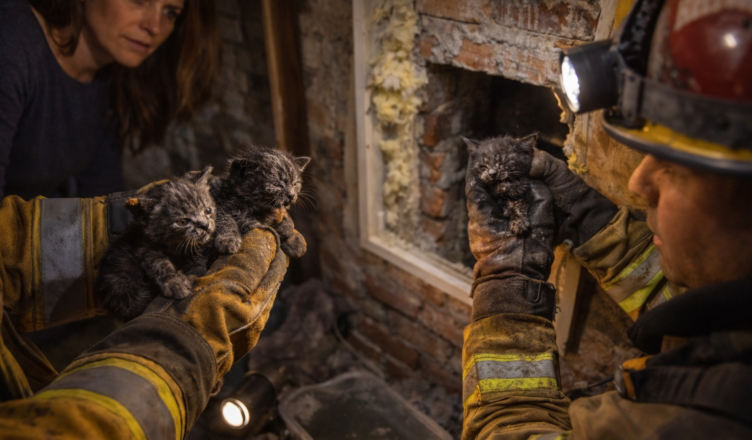
And then a tiny face appeared—gray with soot, eyes squeezed shut, mouth opening in a silent cry that didn’t have enough strength to become sound.
A kitten crawled forward, shaking.
Dana’s chest cracked open.
The firefighter reached in and lifted it gently, and the kitten collapsed into his glove like it had been holding itself together by will alone. It was cold. Too light. Its fur was stiff with soot and its whiskers were singed at the tips.
But it was alive.
They kept going.
A second kitten was wedged deeper, pressed against the brick, barely moving. It took longer to reach—hands carefully feeling through soot and debris, pulling slowly so nothing snapped or crushed.
When the second kitten finally emerged, it didn’t cry.
It just breathed.
A faint, shaky breath like the smallest engine struggling to restart.
The firefighters didn’t stop there.
“One more,” someone said.
Dana’s heart lurched.
The third kitten was stuck higher up, beyond reach from the cleanout, likely perched on a narrow ledge of brick where the flue narrowed. The sound of its mew was weaker now, fading in and out like a radio losing signal.
They tried a camera scope. They tried reaching tools. The chimney was tight, old, uneven.
Minutes stretched.
Dana stood on the basement stairs with her hands clasped so tightly her fingers hurt, staring at the soot-black brick like she could will it to open.
“Please,” she whispered, not sure who she was talking to. “Please.”
Finally, the captain made a call.
“We’re opening the wall.”
No hesitation. No debate. Sometimes you break a house to save a life.
They cut into drywall, peeled insulation back, and exposed the chimney chase. The air filled with dust and the sharp smell of burnt soot. Behind the brick, the faint cry came again—so weak it sounded like air escaping.
The firefighter reached through the opening and guided a gloved hand down between brick and framing until his fingers touched something soft.
He paused.
Then he moved with reverence, cupping the kitten carefully and lifting it out of the dark.
The third kitten was alive.
Barely.
Its body was limp with cold. Its mouth opened once, silently, then closed. Its eyes didn’t fully open at all, just fluttered like it was too tired to see.
Dana made a sound she didn’t recognize—half sob, half relief—and the firefighter handed the kitten to her like it was something sacred.
“Go,” he said. “Warmth. Now.”
Dana ran.
She wrapped the kittens in towels fresh from the dryer, pressed them against her chest, and drove to the emergency vet with her hazard lights on, whispering, “Stay with me. Stay with me,” over and over like it was a spell.
At the clinic, they moved fast.
Warm IV fluids. Heated oxygen. Tiny syringes of glucose. They rubbed little bodies with towels until fur fluffed again. A vet tech held the weakest kitten against her skin under her scrub top because sometimes body heat is the only thing faster than medicine.
Dana watched, shaking, feeling helpless and oddly angry—at whoever let them get in, at whatever terrified mother cat had lost them, at the world for being so casual about small suffering.
Hours passed.
Then the smallest miracle: the weakest kitten lifted its head.
Just a fraction.
Then it mewed—one thin, raspy sound—and Dana started crying so hard she had to sit down.
The vet smiled gently. “That’s a fighter,” she said.
All three survived the night.
Two days later, they were eating from a bottle. A week later, their eyes were clearer, their fur soft again, their voices louder.
Dana fixed the chimney.
She paid for a cap and mesh and sealing and everything she should’ve done years ago. Not because she suddenly cared about home maintenance, but because she couldn’t stand the thought of that brick tunnel ever turning into a coffin again.
And every night for weeks, when the house settled and the wind touched the roof, Dana listened anyway—just in case she ever heard that tiny, impossible sound again.
Because now she knew:
Sometimes a chimney doesn’t just hold smoke.
Sometimes it holds a heartbeat.