The dump was quiet in the early morning, before the bulldozers woke up.
Mist hung low over the piles, turning plastic and broken furniture into ghost shapes. Crows hopped between trash bags like they owned the place. The air smelled like wet cardboard and old food and something sharp you couldn’t name.
Mateo was walking the perimeter with his pickup and his coffee when he heard it.
Not a cry. Not a bark.
A thin, frantic tap-tap-tap—like fingernails on glass.
He stopped, engine ticking as it cooled, and followed the sound past a mound of busted drywall and twisted metal shelving.
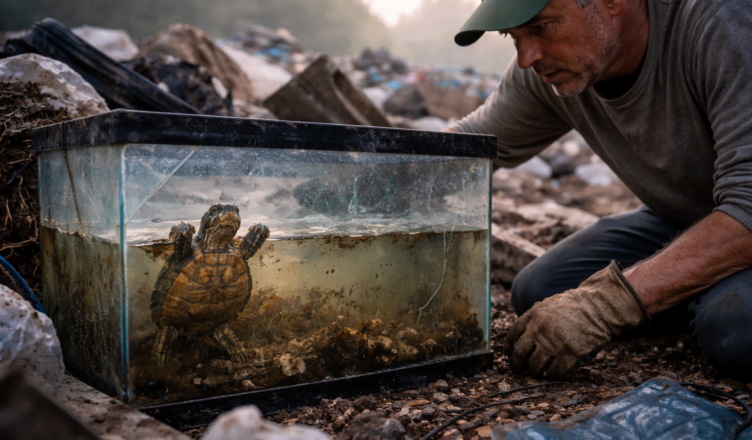
There, half-buried in mud, sat a fish tank.
Not a big one—maybe ten gallons—cracked along one corner, tilted at an angle like it had been tossed from a car. A few inches of dirty water sloshed inside, brown with silt.
And clinging to the glass with both front feet was a tiny turtle.
A baby red-eared slider, no bigger than a cookie.
It wasn’t swimming. It couldn’t. The water was too shallow and too cold, and the crack had let mud seep in until the bottom looked like soup. The turtle kept tapping the glass with its claws—tap-tap-tap—over and over, like it believed the sound could summon a door.
Mateo’s chest tightened.
People dump fish tanks all the time. They dump the tank, the filter, the decorations, like it’s all the same kind of trash.
But the turtle wasn’t trash.
It lifted its head when Mateo leaned closer, eyes small and dark, mouth opening once like it was trying to breathe better. One back leg looked swollen, rubbed raw from scrabbling on gravel.
Mateo didn’t hesitate.
He pulled his gloves on, lifted the tank carefully, and saw the worst part: along the cracked edge, the turtle’s shell was scraped, fresh and pale where it had been grinding against glass trying to climb out.
It had been trying to escape for a long time.
And it had been doing it silently.
That was what wrecked him—how the world only hears animals that can scream.
Mateo carried the tank to his truck like it was something fragile and valuable. He poured the filthy water out, gently scooped the turtle into his palm, and felt how cold it was.
Not dead-cold.
But close.
He drove straight to the wildlife center, one hand on the steering wheel, the other holding a plastic container lined with a towel.
At intake, the volunteer took one look and moved fast.
Warmth first. Always warmth.
They placed the turtle in a shallow heated tray, slowly raising the temperature so it wouldn’t shock the body. They cleaned the abrasions on the shell. They checked the swollen leg—sprain, maybe a fracture, hard to tell on something so small.
The volunteer glanced at Mateo. “How long do you think it was out there?”
Mateo swallowed. “Long enough to start tapping.”
She nodded, understanding exactly what he meant.
The turtle didn’t eat the first day. It just sat, barely moving, eyes half-closed, like the effort of staying alive had taken everything. The second day, it lifted its head when food was offered. On the third day, it snapped at a tiny piece of worm with a sudden, fierce bite that made the staff laugh with relief.
Life returning always looks a little angry.
Weeks passed.
The leg improved. The swelling went down. The shell scuffs faded into thin pale scars. The turtle grew stronger in clean water, learning again what water was supposed to feel like: not cold sludge, not shallow prison, but space.
On release day, Mateo came back.
They met at a quiet pond behind the center, a place ringed with reeds and lily pads. The air smelled green and alive. Birds called overhead like the world was normal.
The volunteer handed Mateo a small container.
Inside, the turtle blinked up at him—bigger now, steadier, no longer tapping at invisible walls.
Mateo crouched at the water’s edge and tipped the container gently.
The turtle slid out and paused on the mud for a second, head lifted, tasting the air like it was deciding whether to trust this new world.
Then it moved.
Not frantic.
Not desperate.
Just a smooth, stubborn crawl into the pond.
Water closed over its shell.
It swam—strong strokes, clean and sure—toward the reeds and disappeared into the green like it had always belonged there.
Mateo stayed crouched long after it was gone.
Because somewhere in the dump, there was still a cracked tank and a pile of trash, and the memory of a tiny creature tapping on glass until someone finally listened.
And now, for the first time, the pond didn’t feel like scenery.
It felt like justice.