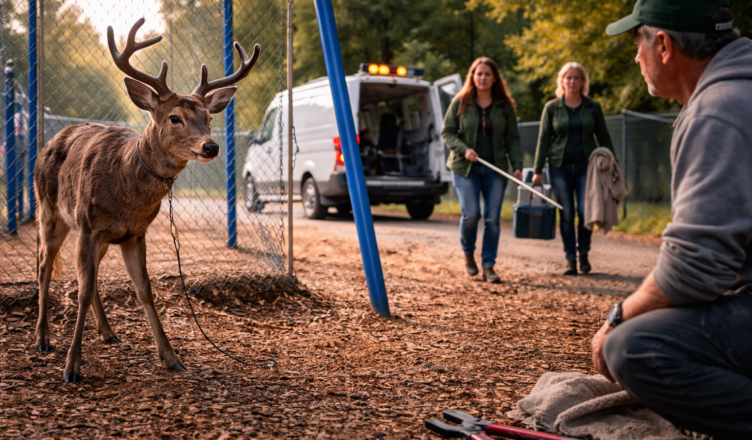
It was the wrong place for a deer.
That was the first thing people said when they saw him—standing inside the chain-link fence of the elementary school playground like he’d wandered in by mistake and couldn’t find the way out. The second thing they noticed was that he wasn’t running.
He should’ve bolted the moment a car door closed. He should’ve cleared the fence line and vanished into the trees behind the baseball field.
Instead, he stood beside the swing set with his head low, breathing hard. His legs trembled as if they couldn’t decide whether to hold him up. And around his neck—half hidden under the scruffy winter coat—was a thin wire.
Not a collar.
A snare.
It cut into the fur and disappeared into swollen skin. Every breath pulled it tighter. Every swallow made him flinch. The wire trailed behind him in a cruel line, snagged on the fence at an angle that forced his head to stay low, like he was bowing to the playground.
A janitor named Marco was the first to get close.
He approached with slow steps, hands open, not looking directly into the deer’s eyes. He knew enough about wildlife to know fear travels through a body faster than logic.
The deer watched him anyway.
His eyes weren’t wild.
They were tired.
Marco could see the ground was churned near the fence—scrapes where the deer had pulled and twisted, trying to free himself until his strength ran out. There were bits of fur stuck to the chain-link where the snare had dragged him back again and again.
He’d been fighting alone for hours.
Maybe all night.
Marco called wildlife rescue and waited by the gate, keeping the yard quiet, sending the curious teachers back inside. The kids pressed faces to classroom windows, silent for once, watching.
The deer shifted once and the wire tightened. He made a small sound—barely a grunt—but it was enough to make Marco’s stomach flip.
“Easy,” Marco whispered. “Easy. Help’s coming.”
When the rescue team arrived, they moved like people who had done this before and still hated it every time.
One woman carried a tranquilizer pole. Another carried bolt cutters and a thick blanket. They didn’t rush into the fence. They didn’t corner him.
They waited for the deer to settle, for his breathing to slow, for the moment his exhaustion outweighed his instinct to flee.
Then—quick, clean—the dart.
The deer startled, took two stumbling steps, and sank to his knees like his body had been waiting for permission to stop.
Marco exhaled like he’d been holding his breath since dawn.
The rescuers covered the deer’s eyes with a towel and worked fast. Up close, the wire was worse than it looked. It had cut deep enough to leave a raw ring. Infection had started. The skin was hot and swollen.
One rescuer slid a finger under the wire and shook her head slightly.
“This would’ve killed him,” she murmured. Not dramatic—just factual.
They clipped the wire.
The sound was small. A metallic snip that didn’t match the weight of what it meant.
The wire loosened. The deer’s neck rose a fraction, free from the forced bow. Even sedated, his body seemed to relax, muscles unclenching like they’d been locked for days.
They cleaned the wound quickly and applied antibiotic spray. They checked his breathing. Checked his eyes. Checked for other injuries.
When they lifted the towel from his face, Marco saw something that stayed with him forever:
Tears.
Not human tears, not crying the way people cry—but wetness at the corners of the deer’s eyes, from stress and pressure and pain. It made him look heartbreakingly young.
They loaded the deer carefully into a trailer lined with straw.
Marco watched, hands shoved into his pockets, jaw tight.
“Will he make it?” he asked.
The lead rescuer hesitated just long enough to be honest.
“If the infection hasn’t spread too far,” she said. “Yes. And he’s strong. He fought hard.”
The trailer door closed. The engine started. The deer disappeared down the street past the playground, past the school sign, past the normal world.
Two weeks later, Marco got a call.
The deer had survived. Antibiotics worked. The swelling went down. The wound was healing clean. He was eating, moving, alert. He’d stopped flinching every time he swallowed.
Release day was at dusk, at the edge of a wooded preserve far from fences and swings and windows full of watching children.
Marco came anyway.
When they opened the trailer door, the deer hesitated—just for a second—nostrils flaring, reading the air like it was a new language.
Then he stepped out.
One slow step. Then another.
He lifted his head high this time, neck stretching, free. The scar was still visible in the fur, a thin ring that would never completely disappear.
He looked back once.
Not at Marco specifically. Not in gratitude the way people want.
Just… a pause. A check. Like he was making sure the world behind him wasn’t going to tighten again.
Then he ran.
Not limping. Not stumbling.
Running the way he should have been able to run the first time—fast, clean, silent—vanishing into the trees as if the playground had been a nightmare someone else had dreamed.
Marco stood in the fading light until the woods went still.
And later, when kids screamed on the swings and laughter filled the yard again, the fence didn’t feel as harmless as it used to.
Because once you’ve seen a deer bowing to a playground…
You never look at wire the same way.