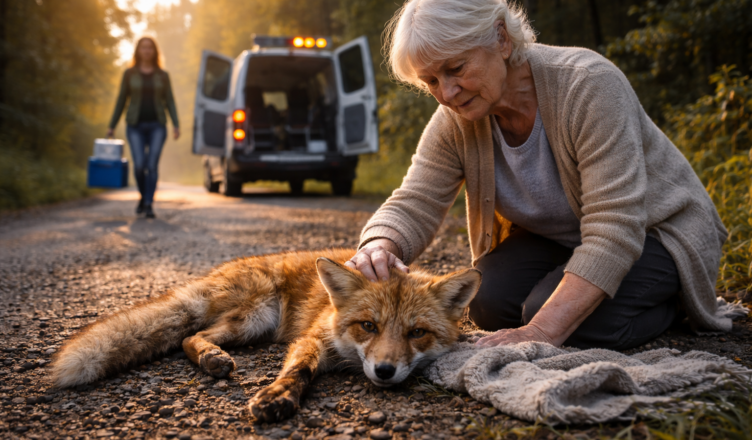
It wasn’t supposed to happen like this.
The truck had barely slowed down before it hit the fox, sending her skidding across the road in a blur of orange fur and broken glass. By the time the driver realized what he’d done, he had already passed her.
She wasn’t dead.
But she wasn’t going anywhere.
Her front leg was pinned, the bones crushed and bent at an angle that made her tremble with every shallow breath. Her head was down, eyes wide, mouth slightly open in a way that wasn’t natural.
She couldn’t move.
The driver didn’t stop. He kept going.
It was only a few minutes before someone else came—an old woman with a cane who was taking a morning walk. Her steps slowed when she saw the flash of fur. She was a creature of habit, someone who had walked this road for years without needing to notice what was in the ditches. But that morning, something caught her attention.
At first, she thought it was a shadow. A piece of cloth caught in the wind.
But no.
It was the fox, lying there in the middle of the road, face pressed to the gravel, eyes too wide to be resting. The woman’s heart turned over when she saw the blood—the dark streak that led to the road’s edge.
She stopped.
For a moment, the old woman just stood there, gripping her cane. She didn’t know what to do. She didn’t have the strength to lift the fox, to carry it anywhere. But she couldn’t just leave it there, either.
She could feel her heart beat a little faster as she crossed the road and kneeled beside the animal.
At first, the fox didn’t look at her. Its body was still, the chest rising and falling with strained breaths. There was something unnatural about its stillness, like it was waiting for death to arrive.
The woman reached out, gingerly, and placed a hand near the fox’s head. She didn’t touch it—just hovered, feeling the warmth of life under her palm.
She spoke softly to it. Not with words the fox would understand, but in the same way one speaks to a hurt child—calm, soothing. “It’s okay. You’re going to be okay.”
She knew it wasn’t true. It couldn’t be. But she said it anyway.
Her first instinct was to call animal control, but the nearest clinic was miles away, and she knew it would take too long. The fox would be gone long before anyone could arrive.
Then, an idea came to her.
A little-known fact about the small village she lived in: there was a wildlife rehabilitation center, hidden in the woods, run by a woman who had dedicated her life to saving the creatures no one else wanted to save. She was a kind of healer for animals that had nowhere to go.
The woman called the center and explained the situation as calmly as she could, detailing the fox’s condition. The voice on the other end of the line was calm and efficient.
“Stay with the fox,” the woman on the phone said. “I’ll be there in fifteen minutes. Stay calm, and don’t try to move it.”
The woman nodded, even though she knew the fox couldn’t see her. She kept her hand near its head, rubbing gently, feeling the warmth of its tiny, beating heart. The seconds felt like hours, and the weight of the animal’s pain pressed in on her chest. She stayed, even though she wasn’t sure if she was helping or just delaying the inevitable.
Finally, a white van appeared, rolling up the narrow road with headlights cutting through the early morning mist.
The rescuer arrived quickly, without hesitation, and immediately began assessing the fox’s injuries.
“It’s bad, but it’s not too late,” the rescuer said, gently lifting the fox into a soft blanket. “She’ll need surgery, and we need to get her stabilized, but she has a chance.”
The woman watched as the rescuer carefully carried the fox to the van, wrapped in the soft folds of a blanket. She didn’t know if the fox would make it, but for the first time that day, the fox’s breathing had steadied.
“Thank you,” the rescuer said to the old woman before driving off.
The woman stood there in the fading light, watching the van disappear down the road, and she felt something that could only be described as hope.
The fox was going to live.
It wasn’t a miracle. But it was enough.
Weeks later, she received a call. The fox had survived the surgery and was recovering. It had lost the leg, but it was walking again, adjusting to the change. It was going to be released back into the wild, to roam the forest again.
And when the day came, the fox—limping but determined—walked into the woods where it had once run freely, its body scarred but its spirit intact.
The old woman, standing on her porch that day, saw a flicker of movement at the edge of the trees. She smiled, recognizing the shape, the color, the defiance in the fox’s gait.
The fox had found its way back to the wild, and she had found a way to help.