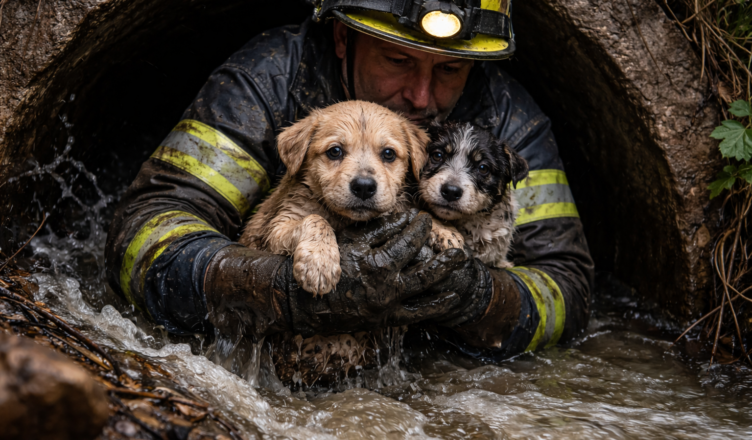
The creek was supposed to be shallow.
That’s what the hikers said later—how it was usually nothing more than a ribbon of water you could step over. But storms don’t care what things are “supposed” to be. They fill ditches and swell culverts and turn quiet places into traps.
By the time the rain stopped, the culvert under the old road was still roaring.
A round concrete tunnel, half-submerged, sucking water through like a throat. Branches and plastic bags and dead leaves jammed against the opening, vibrating with the force. The air smelled like wet earth and gasoline.
And somewhere inside, something was crying.
It wasn’t loud.
It was the kind of sound you miss if you’re in a hurry—a small, ragged yelp that cut off too quickly, as if the animal making it didn’t have enough breath to finish.
The first hiker thought it was a bird.
The second one stopped and said, “No… listen.”
They crouched near the culvert entrance and aimed a flashlight into the darkness.
Two tiny reflections blinked back.
A puppy.
Not a fluffy, clean puppy—this one was plastered with mud, fur clumped in spikes, body wedged on a sliver of concrete ledge above the rushing water. The ledge was barely wider than his paws. Below him, the current churned with floating debris, waiting for one slip.
He was shivering so hard his whole body looked like it was flickering.
And he wasn’t alone.
Behind him, pressed into the curve of the tunnel where the light didn’t reach, another shape moved—smaller, weaker. Another pup, barely visible except for the trembling.
The front puppy kept turning his head back, nudging the darkness with his nose, then looking forward again like he was trying to decide something impossible.
He couldn’t carry the other one.
He couldn’t leave it.
So he did the only thing a baby animal can do when it’s trying to be brave:
He cried for help until his throat started failing.
The hikers called emergency services and stayed on their knees in the mud, holding the flashlight steady like it was a lifeline. Every few minutes the front puppy’s paws slipped on slick concrete and his nails scraped, a sound that made both hikers flinch.
“You’re okay,” one of them whispered, even though it wasn’t true yet. “Stay. Just stay.”
When the fire department arrived, they didn’t rush in.
They stared at the culvert, listened to the water, watched debris slam the opening like fists. A firefighter in a helmet leaned down and aimed his own light inside.
“Two,” he said quietly.
The rescue plan came together in fast, clipped phrases: rope line, harness, spotter, don’t block the flow, don’t spook the dog into the water.
One firefighter clipped into a line and crawled forward, belly on the mud, inching toward the culvert entrance. The tunnel swallowed his light and made him look like he was crawling into a mouth.
Inside, the puppy saw him and panicked.
Not running—there was nowhere to run.
He stood up too fast and slipped.
One paw skated toward the edge.
For half a second his body tilted over the water.
The firefighter lunged with his gloved hand and caught him by the scruff just as the current surged higher.
The puppy screamed—a thin, sharp sound—and then froze, pressed against the firefighter’s arm, eyes wide enough to show white.
“It’s okay,” the firefighter said, voice steady and low. “I got you. I got you.”
He didn’t try to pull the puppy out immediately.
He looked past him, deeper into the tunnel.
The second puppy was there—tiny, barely moving, wedged in the darkest curve. Its head lifted weakly when the light hit it, then dropped again like it was too heavy to hold up.
The firefighter’s jaw tightened.
He shifted his body carefully, keeping one hand braced on the concrete, the other holding the first puppy close so it wouldn’t bolt.
Then he reached deeper.
The water slapped louder. Debris bumped the tunnel’s mouth and made the whole culvert vibrate. The ledge under his chest was slick with algae. One mistake and he’d be dragged too.
He stretched.
Fingers brushing fur.
The second puppy didn’t fight him.
It didn’t have the strength.
He hooked two fingers under its chest and lifted, slowly, carefully, like lifting something made of breath.
As he pulled it toward the light, the first puppy started whining again—urgent, pleading—nose pushing forward as if trying to help.
When both puppies were finally in his arms, the firefighter backed out inch by inch, like reversing a mistake.
The moment he cleared the culvert, the firefighters wrapped both pups in towels and the sound in the air changed.
No more roaring water. No more frantic crying.
Just the small, wet noises of breathing.
The second puppy was cold. Too cold. Its gums were pale, its body limp. The medic pressed a stethoscope to its chest and shook her head slightly, then moved faster—warming packs, oxygen, rubbing the tiny body with a towel like friction could call a soul back.
The first puppy didn’t stop staring at it.
He kept nudging the towel bundle with his nose, whimpering softly, as if saying, Wake up. We made it. Wake up.
In the ambulance, with heat blasting and towels piled high, the second puppy finally moved.
Just a twitch at first.
Then a tiny gasp.
Then a weak little cry that made everyone in the back of the ambulance exhale like they’d been underwater.
The first puppy pressed his whole body against the other one and went still.
Relief looks like that sometimes—silence, finally earned.
At the emergency vet, they treated both for hypothermia and shock. They found cuts on their paws from clinging to concrete, bruises along ribs from being tossed by the current inside the tunnel. But they were alive.
Both of them.
Later, when the storm clouds had moved on and the creek had dropped back down to its harmless ribbon, a volunteer brought the puppies into the shelter’s warm intake room.
The first puppy was still trying to stand between the other one and everything else, even as his legs shook.
He had done that in the culvert too.
He had placed himself at the front of the ledge, body trembling, refusing to leave the weaker one behind.
The volunteer crouched, stroked his muddy head, and whispered, “You did good. You did so good.”
The puppy blinked slowly, as if he didn’t understand praise.
He only understood this:
They were both on dry ground.
And the darkness behind them couldn’t reach them anymore.