They only realized something was wrong because the fox stopped running.
At dawn, on the edge of the industrial park, security guards were used to seeing a flash of red cut across the gravel and vanish between dumpsters. Foxes lived like shadows out there—quick, clever, always just out of reach.
But this one didn’t vanish.
He sat in the open near a chain-link fence, body hunched, tail wrapped tight around his legs like a scarf. He wasn’t sleeping. He wasn’t watching for food.
He was shaking.
And when the guard got closer, he understood why.
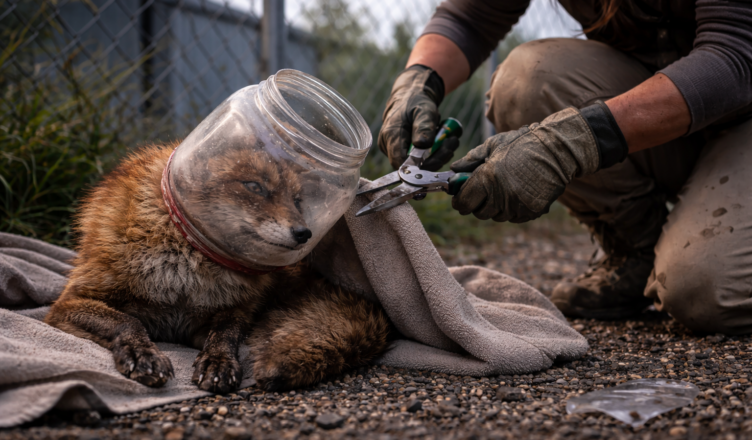
A plastic jar—one of those wide, clear ones meant for pretzels or protein powder—was jammed over the fox’s head. The rim had bitten into fur and skin, wedged tight behind the jaw so it couldn’t be shaken off. Condensation fogged the inside from hot breath. Every few seconds the fox inhaled and the jar sucked inward slightly, like it was trying to breathe for him.
He kept pawing at it.
Scratching.
Dragging the rim over gravel until the plastic squealed.
Nothing helped.
The jar turned his world into a tunnel of panic. It stole his smell, his air, his ability to bite or eat. It trapped his fear right against his face.
The guard called wildlife rescue and tried to keep distance, but the fox could hear footsteps and it made him bolt—three blind, desperate steps before he slammed into the fence with a dull thud.
He staggered backward, jar clacking against metal.
He tried to run again and hit a concrete block.
He stopped after that.
Not because he wanted to.
Because his body had learned that running blind only made the pain louder.
When the rescue volunteer arrived, she didn’t chase him.
She crouched at the edge of the gravel lot and waited, letting her presence become part of the scene until it wasn’t a threat. The fox sat with his head tilted, jar pointed toward her like a weapon he didn’t understand.
She could hear his breathing through the plastic—fast, wet, too shallow.
“You’re okay,” she murmured. “You’re okay. I know. I know.”
She slid a blanket across the ground, slow and flat, like offering a place to land. Then she placed a can of sardines a few feet in front of him and stepped back.
The fox didn’t move at first.
He couldn’t smell the sardines properly, but hunger has its own radar. He inched forward, jar scraping gravel, paws trembling. He tried to lick, but the jar blocked him. Frustration made him thrash his head once, hard—plastic clanging—then he froze again, panting.
The volunteer waited until his shaking slowed.
Then she moved quickly.
A net dropped over his body and pinned him gently to the ground. He fought—wild for two seconds—then the exhaustion took over and he went limp, chest heaving.
The volunteer’s gloved hands found the rim of the jar. It was wedged tight.
Too tight to pull off without tearing skin.
So she did what you do when you can’t undo a trap: you break it.
She pulled out heavy shears and started cutting the plastic. The jar cracked with a sharp pop, splintering like thick ice. The fox flinched at the sound, but she kept cutting—careful not to hit fur, careful not to cut ears.
Piece by piece, the plastic loosened.
Air hit the fox’s face.
Real air. Cold morning air carrying dirt, oil, grass, the whole world.
The fox’s body changed instantly. He stopped thrashing. His breathing deepened like a gasp that had been waiting inside him.
When the last piece of jar fell away, his muzzle was raw—fur rubbed off in a red ring. His lips were swollen. A thin line of blood marked where plastic had bitten in.
But he could breathe.
He could see.
He could smell.
The volunteer eased the net open and backed away.
The fox stayed still for a heartbeat, as if he couldn’t trust the freedom not to snap back.
Then he stood.
Not sprinting.
Not darting.
He took three careful steps forward, nose low, smelling the ground like someone returning home after a long absence. He paused, turned his head once, and looked at the volunteer.
Not gratitude—foxes don’t do gratitude in a human way.
Something older.
Recognition.
Then he trotted off, tail low, body thin, disappearing into the weeds behind the warehouses where the light couldn’t follow.
The security guard exhaled, realizing he’d been holding his breath the whole time.
On the gravel, the broken pieces of plastic jar lay scattered like the shell of something dead.
Just trash, really.
But also proof that sometimes the difference between life and death is whether someone stops long enough to see the wrong thing… and refuses to walk past it.