The first time anyone heard him, they thought it was a pipe.
A thin, steady whine coming from somewhere behind the corner store—high enough to be desperate, low enough to be ignored. The alley smelled like spilled soda and old cardboard. The freezer unit on the back wall rattled and hummed like an engine that never slept.
The whine kept threading through it.
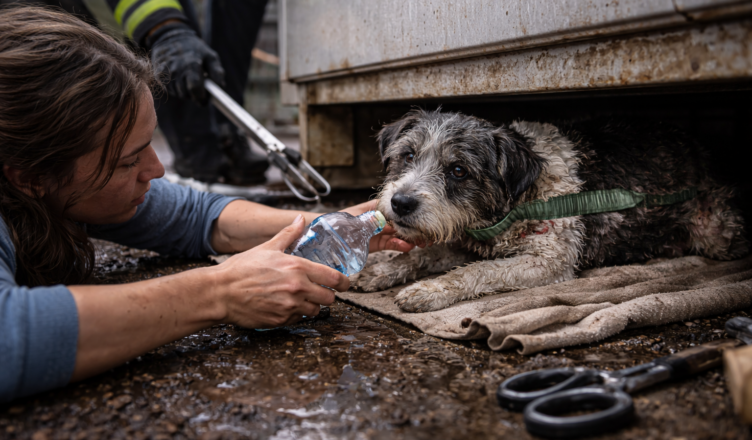
Cassie was taking out trash at closing when she finally followed the sound. She crouched, phone flashlight aimed under the metal lip of the industrial freezer.
Two eyes reflected back at her.
A small dog—maybe eight pounds, maybe less—wedged in the narrow gap beneath the freezer like he’d been poured there. His fur was black and white, but mostly gray with dust. One ear was folded wrong. His mouth opened and shut with shallow breaths, tongue dry and pale.
And around his middle—tight, biting into his skin—was a plastic packing strap.
Not a leash. Not a collar.
One of those hard, flat straps used to bind boxes.
It had cinched into his ribs so deeply the fur had worn away in a red groove. Each breath made the strap cut tighter, like a slow, patient saw.
Cassie’s throat closed.
He had crawled under there to hide. To be safe. To die quietly.
She whispered, “Hey… hey, baby…”
The dog tried to wag his tail.
It barely moved. Just a weak twitch against the concrete, like his body remembered happiness but didn’t have the fuel to perform it.
Cassie ran inside and grabbed the only tools she could find fast—scissors, a dish towel, a bottle of water.
When she crawled down and reached under the freezer, the dog didn’t bite.
He didn’t even back away.
He pressed his forehead into her fingers like her touch was the first thing that had ever felt soft.
But the strap was tight, and the gap was too small to get scissors in safely. If she pulled him, she’d drag the strap against his ribs. If she tilted the freezer, she risked crushing him.
So she did the only thing left.
She called the fire department.
They arrived in minutes—two firefighters and a medic, boots splashing in alley puddles. The whole scene felt ridiculous and sacred at the same time: grown adults kneeling in trash-water for a dog nobody had named.
They slid a flat pry bar under the freezer base and lifted slowly, millimeter by millimeter, while Cassie kept her hands under the dog’s head so he wouldn’t panic when the shadows shifted.
The dog’s eyes stayed locked on her face.
As if he’d decided she was the only stable thing in the world.
When the gap widened enough, the medic reached in with trauma shears. The strap resisted at first—thick plastic, stubborn—then snapped open with a sharp, relieving crack.
The dog flinched like he expected it to hurt.
Then his body softened all at once, like a string inside him had been cut.
They slid him out onto the towel.
Up close, he was worse.
The strap hadn’t just rubbed him. It had bitten into skin. Infection had started. His belly was bloated with hunger and stress. His paws were raw from scrambling across concrete. And his gums were pale in a way that made the medic’s face tighten.
“He’s been in here a while,” she murmured.
Cassie followed the ambulance to the emergency vet in her own car, hands shaking so hard she could barely keep them on the wheel.
At the clinic, they moved fast.
Warm IV fluids. Oxygen. Pain meds. Antibiotics. Cleaning the wound until it stopped looking like a cut and started looking like skin again. The vet didn’t sugarcoat it.
“If you found him tomorrow,” she said, “we might not be having this conversation.”
Cassie nodded once, the kind of nod that keeps a person from falling apart.
They let her sit with him after stabilization.
He lay on a blanket with a tiny bandage around his middle, eyes half-closed, breathing deeper than before. Cassie reached out and placed two fingers against his cheek.
The dog leaned into it immediately.
Not weakly.
Not politely.
With the full weight of trust—like he’d been holding it in for days and finally had somewhere to put it.
“What do I call you?” Cassie whispered.
The dog didn’t answer, obviously.
But his tail—thin little thing—thumped once.
Cassie laughed through tears. “Okay. Okay. You’re alive.”
The shelter offered to take him after recovery. The vet offered to help coordinate rescue placement. Cassie nodded along to everything, trying to be responsible, trying to be logical.
Then the dog—still groggy—reached one paw forward and hooked it gently around her sleeve.
Not pulling.
Just… attaching.
As if he didn’t understand paperwork but understood leaving.
Cassie froze.
The vet watched quietly, then said, “He picked you.”
A week later, Cassie carried him out of the clinic in a soft crate with a new bandage and a new collar that sat loose and safe against his fur.
The scar around his ribs was still there—an ugly ring that would take time to fade.
But when Cassie set him down in her apartment, he walked to the kitchen, sniffed the air, then turned back to look at her like he couldn’t believe the story had changed.
Cassie knelt.
The dog toddled forward and pressed his forehead to her knee, exactly the way he had under the freezer.
Only now, the floor was clean.
The air smelled like home.
And the thing around his body wasn’t a strap anymore.
It was freedom.