The clinic was only two rooms and a porch.
Tin roof, peeling paint, the smell of disinfectant fighting a losing battle against the heat. Out front, a line of people waited with dogs, goats, chickens—whatever they could carry, whatever they could not afford to lose.
Dr. Suri was finishing a stitching job on a stray dog’s shoulder when the boy burst in, breathless.
“Ma’am! The monkey—he’s hurt!”
Everyone in the waiting area turned at once, like the word monkey changed the rules.
Out by the mango trees, a young macaque sat on the dirt with his arm held tight to his chest. His eyes were huge and bright with panic, tail twitching like a metronome. When anyone stepped toward him, he bared his teeth—not in aggression, but in warning.
Don’t touch me.
Don’t trap me.
Don’t make it worse.
Dr. Suri came out slowly, hands open, voice low. “Okay. Okay. Easy.”
The monkey watched her like he was weighing options in real time.
On the ground near him was a piece of torn fishing net—thin strands glittering in the sun. One loop had caught around his wrist. The net had tightened, cutting into skin. Each time he pulled, it bit deeper.
He’d been trapped long enough to make the injury messy.
Blood dried on his fur in dark smears. The hand below the net was swollen and purple, fingers half-curled.
Dr. Suri didn’t lunge. She didn’t chase.
She sat down on the dirt a few feet away and waited, still as stone. The kind of stillness animals understand.
Minutes passed. The clinic sounds continued behind her—murmurs, a dog barking once, someone coughing. The monkey’s breathing slowed from frantic to sharp, then to something closer to normal.
He inched forward once, curiosity and pain arguing inside him.
Dr. Suri slid a banana onto the ground and nudged it toward him with two fingers.
He grabbed it and retreated, eyes never leaving her face.
She offered another. Then another.
Then—when his attention was just soft enough—she did the only thing that ever works with wild fear: she moved fast and clean.
A towel snapped over him like night.
The monkey shrieked, violent for one second, then froze when his world went dark. Dr. Suri’s hands found the trapped wrist through fur and towel, steady and practiced. She pinched the net, lifted it off the swollen flesh by millimeters, and cut.
Snip.
Snip.
The net released with a soft, awful give.
The monkey trembled, body vibrating, then went suddenly still—like his brain couldn’t accept that the pressure was gone.
She loosened the towel enough to check the hand.
It was bad, but not hopeless. Deep cuts. Swelling. Risk of infection. But circulation looked like it might return if she cleaned it quickly and kept him calm.
That last part—the calm—was the impossible one.
Because macaques don’t do calm in captivity. They do panic. They do teeth.
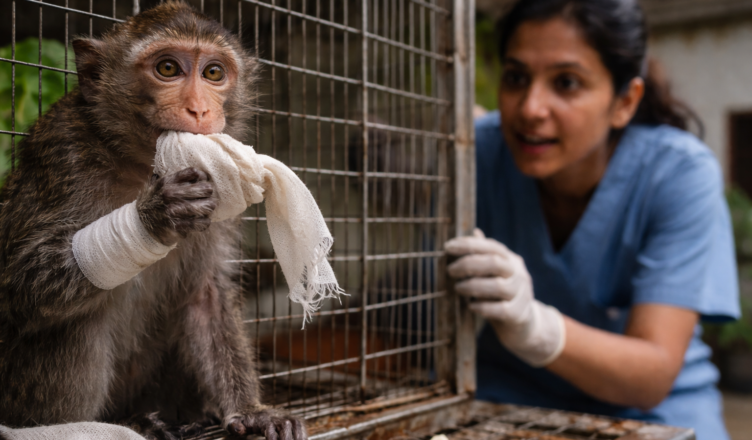
She moved him into a small wire enclosure on the porch, just temporary, just until she could clean and wrap the injury. The monkey paced, then sat, then paced again, eyes darting to every corner, fingers flexing like he was testing whether he still owned his hand.
Dr. Suri cleaned the wound with saline. He hissed and slapped the bars once, but he didn’t bite. Pain makes animals careful.
She wrapped the wrist with gauze and a light bandage, not tight, just protective.
When she stepped back, she exhaled.
And the monkey stared at the bandage for two seconds.
Then he reached out, grabbed it with his good hand, and ripped it off in one perfect motion—like he’d been waiting his whole life for that specific task.
He held the bandage up triumphantly.
Then, because the world is unfair in small comedic ways, he stuffed it into his mouth like it was food.
Dr. Suri made a sound between laughter and despair. “No. No—don’t—”
The monkey chewed.
Spit.
Chewed again.
Then hopped to the corner of the enclosure and—still holding the bandage—watched her like he’d just won something.
But when he moved, his injured wrist scraped the wire.
He flinched hard.
The bravado cracked for a second, revealing the truth underneath: the pain was still there, and he couldn’t outsmart it forever.
Dr. Suri tried again, this time differently.
No big wrap. No tempting loose edges. She applied antibiotic ointment and used a tiny strip of medical tape—flat and difficult to grab—just enough to keep the wound clean without giving him a toy to steal.
He tried to pick at it.
Failed.
Tried again.
Failed.
Finally, he sat down with a frustrated huff, wrist tucked close, eyes half-lidded.
Over the next two days, the monkey returned.
Not inside the enclosure—he wouldn’t allow that twice—but to the porch railing, watching from just out of reach. Every morning, Dr. Suri left a banana and a small dish of water. Every afternoon, she checked the wrist as he ate, applying ointment while he tolerated it with offended dignity.
He never thanked her.
He never needed to.
On the third day, the swelling was down. The color returned to the fingers. He flexed his hand, slow and careful, as if testing whether the world still worked.
Then he did what healthy monkeys do.
He stole something.
Not a bandage this time.
A shiny pen from the clinic desk.
He snatched it, chattered loudly, and bounded back into the mango trees like a little thief with a healed future.
Dr. Suri watched him go, smiling despite herself.
Because sometimes success doesn’t look like gratitude.
Sometimes it looks like a monkey with a better wrist… going back to being a menace.