It was almost midnight when the café’s back door clicked shut and the city exhaled.
Chairs were upside down on tables. The espresso machine hissed its last tired breath. Outside, the streetlights painted everything the color of old honey, and the rain had finally stopped pretending it would ease up.
Noor was wiping down the counter when she heard it.
A soft, scraping sound near the trash bins out back—like a leaf being dragged across concrete. Then a tiny, sharp snuffle.
She opened the back door and the smell of wet garbage and flowers hit her at the same time. The café kept a little planter near the bins—lavender and rosemary, stubbornly alive despite the city.
Something moved under it.
Noor crouched and aimed her phone flashlight low.
At first she thought it was a pinecone.
Then it blinked.
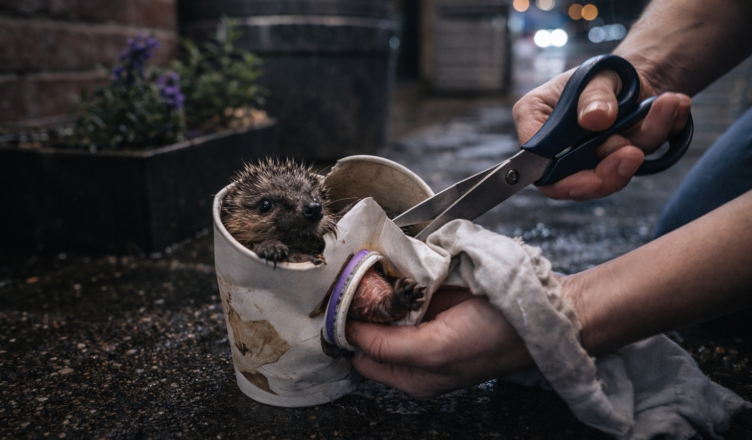
A hedgehog—small and round, spines damp and clumped—was wedged inside an empty paper coffee cup. Not just stuck. Trapped. The cup had collapsed around its body like a sleeve, pinning its legs. Every time it tried to shuffle forward, the rim scraped the ground and the cup slid with it, turning the hedgehog into a tiny, panicked tugboat.
Its breathing came fast. It kept trying to curl into a ball, but the cup wouldn’t let it.
Noor whispered without thinking, “Oh no… oh, baby…”
The hedgehog froze.
Then it tried again, a frantic little push that did nothing but make the cup crumple tighter around its middle.
Noor ran inside and came back with a kitchen towel and a pair of scissors.
She didn’t grab it barehanded. She didn’t yank.
She draped the towel gently over the cup first—darkness, softness, a break from the light. Under the towel, she could feel the hedgehog’s tiny body vibrating, heart hammering like it was trying to outpace the world.
“Okay,” she murmured, more to herself than it. “Okay. I’ve got you.”
She cut the cup slowly, careful not to nick quills or skin.
The paper tore with a quiet rip.
The hedgehog immediately tried to curl—instinct—and for a moment it couldn’t, because its body had been held in a stretched position too long. It trembled, confused, then finally tucked into itself, a small spiky knot shaking in the towel.
Noor waited.
She didn’t poke it. Didn’t force it open. She just waited until the shaking softened.
When the hedgehog finally unfolded, Noor saw the problem she hadn’t noticed before.
A sticky ring of plastic—maybe from a drink lid—was looped around one back leg. It had cut into the skin, swollen and red, and the foot below it looked cold and pale.
It had been caught twice.
By the cup. By the ring.
Noor’s throat tightened.
She called the local wildlife rescue line with hands that wouldn’t stop trembling. They told her what to do: keep it warm, don’t feed it, don’t try to remove the plastic if it was embedded.
She made a nest in a shoebox with a clean towel, punched air holes in the lid, and placed the hedgehog inside. It tried to walk, dragging the injured leg, then stopped and curled into a tight ball again—like stillness was the only defense left.
Noor drove through wet streets with the shoebox on the passenger seat, one hand hovering over it as if her warmth could travel through cardboard.
At the rescue center, a volunteer lifted the hedgehog gently with gloved hands and examined the leg.
The plastic ring was tighter than it looked.
But they got it off.
They cleaned the wound. Gave pain relief. Applied an antibiotic cream. The volunteer glanced at Noor and said softly, “If you hadn’t found it tonight… it might have lost the foot.”
Noor nodded, biting the inside of her cheek so hard it hurt.
She didn’t know why she felt so emotional about something so small. About an animal most people never see, never think about, never make room for in their lives.
But maybe that was the reason.
A hedgehog isn’t supposed to survive in a city alley behind a café. It’s not built for plastic rings and paper cups and wet concrete.
And yet it had tried.
It had pushed and snuffled and dragged itself forward anyway, even when its body was literally trapped in human trash.
A week later, Noor went back to the rescue center to check on it.
The volunteer led her to a warm enclosure lined with leaves and soft bedding. The hedgehog was there, eating slowly, the injured leg wrapped but resting more naturally now.
Noor didn’t reach in.
She just watched.
The hedgehog paused mid-bite and lifted its head slightly, nose working the air.
Not recognition. Not affection.
Just awareness.
Then it went back to eating like survival was a job, not a miracle.
Noor exhaled, smiling the smallest smile.
Outside, the world kept dropping cups. Kept losing plastic rings. Kept filling alleys with things that didn’t belong to living bodies.
But somewhere in a warm room behind a wildlife center, a hedgehog was healing.
And that was enough to make the night feel less cruel.