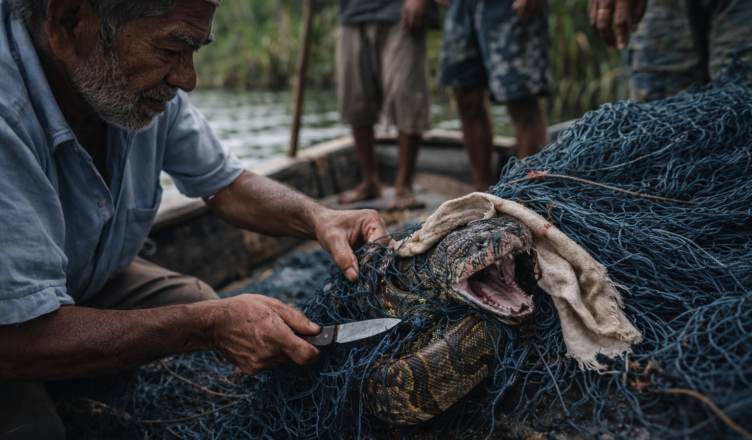
The fishermen didn’t notice it at first because they were looking at the water.
They were always looking at the water—reading the surface, watching for ripples, for flashes, for the little signs that meant food. The net came up heavy that morning, dripping and alive with movement, and everyone smiled the way people do when luck finally shows its face.
Then the net twisted.
Something long and dark rolled inside it, and the mood changed instantly.
“A snake,” one of them said, voice flat.
Not the casual kind of snake you ignore in the grass. This one was thick-bodied, patterned, muscular—caught so tightly in nylon that the mesh had carved grooves into its scales. Each time it tried to pull free, the net tightened, turning panic into a trap that worked harder the more it was fought.
The snake’s head lifted and struck at the air—not to bite, but to warn. Its mouth opened in a silent snap, and its tongue flickered fast, tasting fear.
The men stepped back.
Some grabbed sticks. Someone suggested killing it quickly, getting it over with. Not cruelty—just fear doing what fear does when it doesn’t want to think.
But the oldest fisherman—Rafi—raised a hand.
“No,” he said quietly. “It’s stuck. That’s all. It’s stuck.”
The snake thrashed again, and the net bit deeper across its neck and midsection. A few scales peeled, exposing raw skin beneath. Blood—thin and bright—mixed with the river water dripping from the mesh.
Rafi crouched and studied it like a mechanic studying an engine. Where is the tension? Where is the knot? Where does the trap do its worst work?
He told the others to hold the net steady, not tight—steady.
Then he took out his pocketknife.
The men muttered. The snake hissed. The air held its breath.
Rafi moved slowly, not because he was calm, but because he knew speed would turn this into a strike. He lowered a cloth—an old sack—over the snake’s head, letting darkness settle it. The snake still writhed, but the strikes stopped.
With two fingers, he lifted the net away from the snake’s neck by a millimeter.
Just enough.
Then he cut one strand.
The net loosened slightly.
The snake jerked, and the men jumped back, but Rafi kept his hands steady. He cut again. And again. Each cut reduced the net’s grip, turning it from a fist into a web.
Minutes passed like hours.
The snake’s body trembled with exhaustion. Its breathing—barely visible—came in small muscular waves along its sides. The river smell mixed with blood and nylon and fear.
Finally, one last strand held the midsection, tight and ugly.
Rafi lifted it carefully and sliced through.
The net fell away.
The snake didn’t shoot off like people expect snakes to do.
It just… lay there.
Free, but stunned. As if its body couldn’t compute the absence of pressure. Its head stayed under the cloth, still, tongue no longer flickering.
Rafi stepped back and waited.
One second.
Two.
Then the snake slowly lifted its head, pushed the cloth away, and looked at the circle of humans around it—faces tense, hands gripping sticks they didn’t use.
For a heartbeat, nobody moved.
Then the snake slid forward, dragging part of its body in a slow, pained line. The cuts on its scales glistened. It paused once, coiling slightly, as if deciding whether escape was worth the movement.
Then it chose the reeds.
It disappeared into the wet grass with quiet efficiency, leaving only a dark trail in the mud where it had been.
The men exhaled like they’d been underwater.
Someone laughed shakily. Someone swore. Someone said, “It could’ve killed us.”
Rafi wiped his knife on his pants and shook his head.
“It didn’t,” he said. “It wanted to leave. Same as we would.”
They repaired the net later, knotting new strands where Rafi had cut.
But when they pulled it up again, it felt lighter—not with fish, but with something else.
Like for once, the river had taken nothing.
And that mattered.