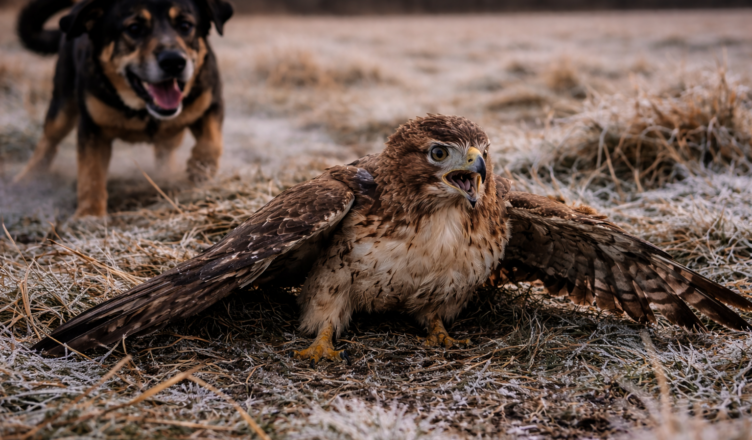
The hawk was supposed to win.
That’s what the field was for—open grass, low brush, nowhere to hide. The kind of place where wings meant advantage and surprise meant everything.
It was late winter, pale and hard. The sun sat low and sharp, turning the frost into glitter. A rabbit moved along the hedgerow, stopping every few steps, ears up, listening. Hunger makes you brave. Hunger makes you visible.
The hawk dropped out of the sky like a thrown knife.
No warning. No sound. Just shadow and speed and the sudden rush of air as talons opened.
The rabbit bolted—too late.
The impact was violent and clean. The hawk pinned the rabbit hard enough to press fur into frozen mud. The rabbit screamed once—a thin, tearing sound—and thrashed so fast it looked like the ground itself was shaking.
The hawk’s wings spread wide, shielding its kill. It leaned in, beak searching for the exact place to end it quickly.
Then the dog came.
A farm dog, off-leash, barreling across the field with the reckless confidence of something that has never had to be prey. Maybe it had been chasing a smell. Maybe it had been bored. Maybe it had heard the scream and decided it belonged to him.
He hit the scene like a storm.
Barking, snapping, lunging—his body all teeth and noise and momentum. The hawk flared, startled, trying to lift off with the rabbit still under its grip.
But the rabbit twisted at the same time.
Fur tore free.
The rabbit shot out from under the hawk’s shadow and vanished into the brush like a miracle, leaving a few tufts behind like proof it had been real.
The hawk tried to follow.
That was the second mistake.
Because it didn’t climb high enough.
In panic, it skimmed low over the grass, wings beating hard, talons still half-curled, mind narrowed to escape.
The dog jumped.
His teeth caught a wingtip—just for a fraction of a second, just enough.
The hawk spun sideways and crashed into the frozen ground with a sound that didn’t match its size. Feathers exploded outward. One wing bent wrong, trembling, refusing to fold back into place.
The dog circled, barking, excited by the sudden chaos.
The hawk tried to stand. Tried to threaten. Tried to be what it was meant to be.
But an injured raptor on the ground is a different animal.
It hopped once, awkward, dragging the wing. Its eyes—bright, furious, terrified—locked onto the dog, then flicked to the sky like it couldn’t believe the sky wasn’t helping.
The farmer saw it from the porch and ran.
He didn’t shout at the hawk. He shouted at the dog.
“BACK! BACK!”
The dog hesitated, then bounded away in wide loops, still amped, still barking at the air like he’d just won a championship he didn’t understand.
The hawk stayed where it fell, chest heaving, beak open, breathing too fast.
The farmer approached slowly with a blanket and thick gloves. He knew better than to mistake fear for weakness—hawks fight even when broken.
When the blanket dropped over its body, the hawk jolted, talons scraping, then went still. Darkness changed the math. Darkness made it pause.
He lifted it carefully, feeling the rapid heartbeat through fabric, the violent, tiny engine that refused to quit.
At the rehab center, the X-ray confirmed what the field already knew.
Fracture.
Not catastrophic, but serious. A wing injury isn’t like a limp. A wing injury is a sentence if it doesn’t heal perfectly. Hunting requires precision. Survival requires speed. There is no room for “almost” in flight.
They set the wing. Wrapped it tight. Put the hawk in a quiet enclosure where it could be angry in peace.
For days, it refused food.
Not because it wasn’t hungry.
Because it was furious.
At the human hands. At the walls. At gravity. At the fact that it had grabbed life and lost it to a dog that didn’t even need to eat.
Then, one morning, it ate.
A small piece. Then another.
Weeks passed. Feathers regrew. Muscle returned. The wing began to hold itself properly again, inch by inch, like a prayer being answered slowly.
When they moved it to the flight cage, the hawk tested the air once—one hard jump, wings half-open—and wobbled, catching itself on a perch.
It didn’t collapse.
It tried again.
And again.
Until one day, it crossed the cage in a clean, steady line—no wobble, no panic, just a quiet, perfect glide.
Release day came with clear sky.
They carried the crate to the edge of the same field, frost gone now, grass soft with early spring. The farmer stood with his dog on a leash this time, hand tight around it like a promise.
They opened the crate.
The hawk stepped out and froze, head turning, scanning the land like it was rereading a story it thought it knew.
It looked once toward the hedgerow.
Maybe the rabbit was there. Maybe it wasn’t.
Then the hawk lifted its wings—fully, beautifully—caught a rising current, and climbed.
Higher. Higher.
Until it was just a shape against the sky again.
The dog whined softly, ears forward, watching.
The farmer exhaled.
Because sometimes the hunt doesn’t end with a kill.
Sometimes it ends with a lesson.
And sometimes, in the mess of it all, the prey gets away.