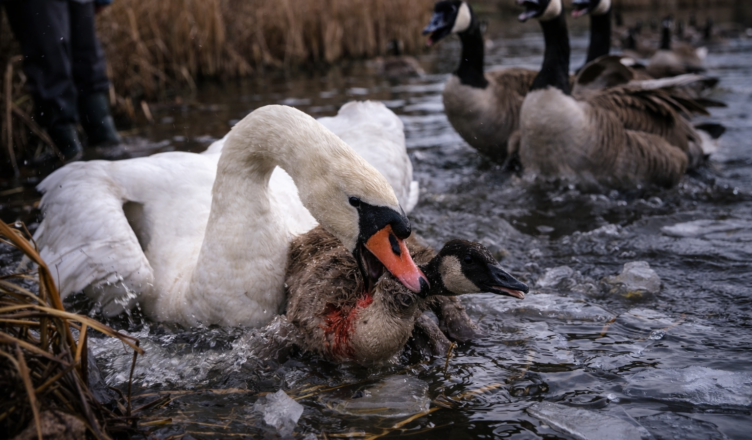
Everyone thought the geese owned the pond.
They were loud enough for it. Big enough. Mean enough. They stood at the edge like bouncers, chests out, necks high, hissing at anything that dared to look thirsty.
But that morning, the pond belonged to a swan.
An old swan—scarred, heavy-bodied, one wing held slightly lower like it remembered pain. He moved with the slow certainty of an animal that had survived too many winters to be intimidated by noise.
He glided near the reeds where the water was calmer, where the thin ice hadn’t fully melted, where the fish came shallow. And behind him, like a shadow that couldn’t keep up, a young goose trailed too close.
Maybe it was hunger.
Maybe it was a mistake.
The gosling—too big to be a baby, too small to be brave—pecked at the swan’s tail feathers once, quick and stupid, like a kid flicking a stranger’s hat.
The swan didn’t move at first.
Then he turned.
The change was immediate. Not rage—something colder. A decision.
He surged forward in one smooth, powerful push, water rolling off his chest like armor. The gosling tried to backpedal, wings flapping awkwardly, panic making it clumsy.
Too late.
The swan struck with his wing—hard.
Not a slap. A blow.
It hit the gosling’s side and knocked it sideways into the shallow ice near the bank. The ice cracked. The gosling shrieked, flailing, feet scrabbling, and the swan followed, pressing in, driving the point the way animals do when they’re not trying to teach lessons—when they’re trying to remove a problem.
The geese exploded.
Hissing. Wings out. Bodies charging.
They poured toward the swan in a frantic half-circle, but geese don’t fight like swans. They bluff. They threaten. They chase.
The swan didn’t bluff.
He grabbed the gosling by the neck and shoved it down into the water—just long enough to make the gosling’s eyes go wide, just long enough to make the geese lose their minds, just long enough for the crowd of bodies to become chaos.
Someone screamed from the walking path.
A man dropped his coffee and sprinted toward the edge, slipping in mud. Another person pulled out a phone, filming, breathless like it was entertainment.
But a woman who volunteered at the wildlife rehab didn’t film.
She ran straight into the reeds.
“HEY!” she shouted, voice sharp as a thrown rock. “HEY!”
She grabbed a fallen branch and slammed it into the water—not at the birds, but beside them, making a wall of noise and spray.
The swan recoiled slightly, startled. The geese flinched too, their panic redirecting.
In that half-second, the gosling lurched free and thrashed toward the bank, coughing water, wings useless.
The swan surged again.
The woman stepped between them in the only way humans can between wild things—by being stupidly large and loud and committed.
She waded knee-deep, branch held out, splashing and shouting, forcing the swan to choose: fight her or give up the gosling.
He chose to give up the gosling.
Not kindly. Not gently. Just… with a hard, final stare that said this is over.
The geese dragged the gosling onto the muddy edge, honking like sirens. The gosling lay there trembling, one leg twisted wrong from the ice crack, chest pumping too fast, feathers plastered to its body.
It was alive.
But barely.
The woman crouched slowly, hands raised so the geese wouldn’t attack her. She waited until they backed off just enough—until fear outweighed fury—then she grabbed the gosling with a towel she kept in her car for exactly this reason.
It didn’t fight. It only shook.
At the rehab, the X-ray showed a fractured leg and bruising along the ribs. Water in the lungs. Shock. The vet’s mouth tightened as she cleaned mud from the beak.
“People think it’s ‘nature’ and walk away,” she muttered. “But half the time it’s just… stress. Crowding. Hunger. A fight over space.”
No villain.
No mercy either.
The gosling spent a week under heat lamps, wrapped in soft cloth, learning how to breathe without panicking. The leg was splinted. The lungs cleared slowly. Every night it slept with its head tucked under its wing like it was trying to disappear from memory.
When it finally stood again, it did it carefully—placing weight like it didn’t trust the world to hold.
On release day, the woman returned to the pond at sunrise.
The geese were there, of course—loud, bold, acting like they owned everything.
The swan was there too, farther out, silent and watchful, gliding like a shadow.
The woman opened the crate.
The gosling stepped out and froze.
It stared at the water. The pond that had almost killed it. The pond that had almost taught it the last lesson.
Then, slowly, it moved toward the edge.
Not rushing. Not showing fear.
Just stepping forward anyway.
It slid into the water with a soft ripple and paddled toward the geese, who circled it at first, honking and suspicious. Then, one by one, they accepted it back into the moving, noisy crowd.
The swan watched from a distance.
He didn’t charge. He didn’t threaten.
He simply turned, and with one lazy stroke of his wings, he glided away—back to the far reeds, back to the quiet section of the pond.
Back to the place that belonged to someone else, the way it always had.
Not because he was evil.
Because wild animals aren’t built for forgiveness.
They’re built for territory.
And survival.