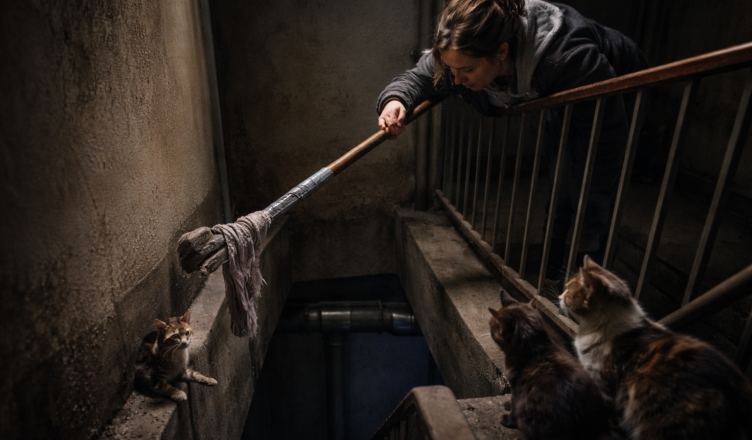
The building’s power flickered twice before it died for good.
Hallway lights vanished. The hum of elevators went silent. Somewhere below, a door slammed, and then the whole place settled into the kind of darkness that makes people talk softer without realizing it.
On the 11th floor, a woman named Mila heard the first cry.
It was faint—thin and urgent—coming from the stairwell.
At first she thought it was a baby. Then it came again, sharper, and she recognized it with a sick drop in her stomach.
A kitten.
She grabbed her phone flashlight and pushed the stairwell door open.
The smell hit first: dust, damp concrete, and something metallic—like old water in pipes. The echo made everything sound farther away, like the building was swallowing the noise.
The cries were coming from below.
Mila went down one flight at a time, calling softly, “Hey… hey baby… where are you?”
On the 9th-floor landing, her light caught movement.
A small cat—mother—pressed against the wall, fur patchy and dull, sides hollow like she’d been living on luck. Two kittens were clinging to her belly, latched on, kneading with desperate little paws.
The third kitten wasn’t there.
The mother cat’s eyes were huge. She looked straight at Mila, then turned her head toward the gap under the stairwell railing.
And cried.
Mila stepped closer and aimed the light down through the metal bars.
Eleven floors below, the stairwell dropped like a throat. Somewhere between the 9th and 8th floor, on a narrow ledge meant for nothing but dust, a tiny kitten lay wedged behind a pipe.
He wasn’t moving much.
His body was damp, fur stuck in spikes. One back leg dangled at an angle that didn’t belong to a living thing. And when he tried to crawl, he didn’t get anywhere—just a trembling inch, then stillness, then another broken cry.
He had fallen.
Or slipped.
Or been carried down and dropped by gravity when the mother couldn’t grip anymore.
The mother cat paced in frantic little circles, returning to her two kittens, then rushing back to the railing, meowing down into the void like her voice could become hands.
Mila’s heart hammered.
The ledge was narrow. The drop was real. The building was dead—no elevator, no maintenance, no quick fix. Just her and a flashlight and a decision.
She ran up to her apartment and came back with what she had: a laundry basket, a scarf, duct tape, and a long broom handle.
She taped the scarf to the end of the handle, making a soft sling. It looked ridiculous. It looked impossible.
Then she leaned over the railing and lowered it down slowly, arms shaking, breath held like she could control gravity by refusing to inhale.
The mother cat watched with a kind of intense stillness Mila had never seen in an animal—like all her panic had condensed into one point of focus.
The scarf swung near the ledge.
The kitten cried again, a tiny sound that barely made it up.
Mila lowered a little more, guiding the sling toward him. But the space was awkward; the pipe blocked the angle. Each time she tried to scoop, the scarf brushed his fur and slid off.
Minutes passed. Felt like hours.
The kitten’s cries got weaker.
Mila whispered, not prayers exactly, just words to keep herself from falling apart. “Come on. Come on. Please.”
The mother cat suddenly did something Mila didn’t expect.
She picked up one of the kittens by the scruff—carefully, like she was carrying glass—and brought it to the railing. She set the kitten down beside Mila’s hand, pressed her face into it once, then looked back at Mila as if offering collateral.
As if saying: I’m here. Don’t stop.
Mila swallowed hard and adjusted the sling again, wrapping the scarf tighter so it would catch.
This time, when it reached the ledge, she didn’t try to scoop the kitten sideways.
She lowered it directly beneath his chest and then lifted—slow, slow—until his weight tipped into the cloth.
The kitten slipped.
For one terrifying second, he slid off the scarf like a wet leaf.
Mila jerked upward instinctively, and the scarf snagged under his front legs. His claws hooked fabric. He screamed—one sharp, furious sound—and then held on.
Mila pulled.
Her shoulders burned. The broom handle bowed with strain. The scarf crept upward inch by inch, the kitten dangling, spinning, held by pure stubbornness and one cheap knot of duct tape.
When he finally cleared the railing, Mila collapsed backward onto the concrete, dragging the kitten against her chest.
He was alive.
So small. So light. Shaking like a motor. His leg was worse up close—swollen, limp, wrong. He tried to kick and couldn’t. He pressed his face into Mila’s sleeve and made a sound like he was trying to purr through pain.
The mother cat was on him instantly, sniffing, licking, counting him like he was a number she couldn’t afford to lose.
Then, incredibly, she did something else.
She bumped her forehead against Mila’s wrist—once, quickly—then returned to her kittens, curling around all three like a living wall.
Mila didn’t cry until she had all of them in a box with towels and her coat, and she was running down the stairs into the night to her car, phone in her teeth, calling the emergency vet on the last 2% battery.
At the clinic, the vet confirmed a fracture and dehydration, but the kitten’s lungs were clear. No internal bleeding. A splint, pain meds, fluids. A chance.
Mila sat on the floor in the exam room while the mother cat nursed, eyes half-closed, finally letting her body loosen.
The building would get power back tomorrow. Or the next day.
The elevators would hum again. Lights would return. People would forget how fragile everything felt.
But Mila wouldn’t forget the stairwell.
She wouldn’t forget the way a mother cat stared into a drop she couldn’t climb, screaming for a baby she couldn’t reach.
And she wouldn’t forget the moment that tiny kitten—dangling in a scarf, leg broken, body shaking—still chose to hold on.