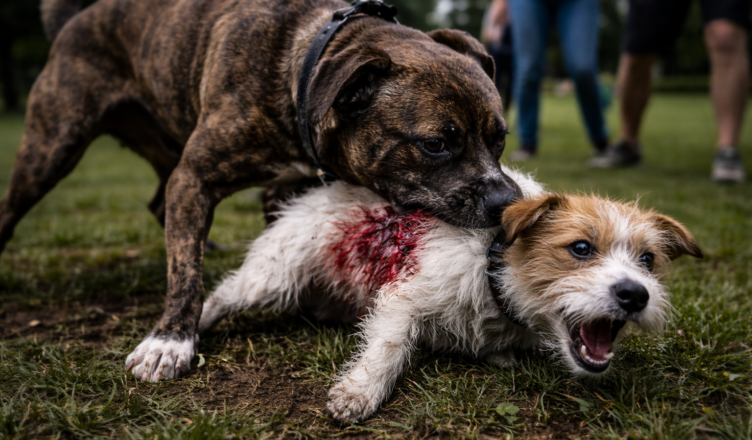
It happened so fast most people only heard it.
A sharp yelp—high, raw—cut through the quiet of the neighborhood park. Heads turned. A few dogs barked back. Someone laughed like it was nothing.
Then the screaming started.
By the time anyone reached the bushes near the walking path, the terrier was already pinned. Not by a car. Not by a person.
By another dog.
A bigger dog—muscle and panic and teeth—had clamped onto the terrier’s side and wouldn’t release. The terrier’s legs flailed uselessly, nails tearing up dirt, body twisting in desperate arcs that did nothing but pull skin tighter against jaws.
The bigger dog wasn’t “mean” in a clean, simple way.
It looked terrified.
Its eyes were wild and unfocused, ears flat, body shaking like it was fighting something inside itself. It wasn’t growling for dominance. It wasn’t posturing.
It was locked in a storm it couldn’t exit.
People shouted. Someone grabbed a leash. Someone else hit the bigger dog’s back with a shoe, then screamed when that did nothing. A man tried to pry the jaws open with his hands and recoiled, bleeding.
The terrier’s yelps turned thin.
Not weaker—just different.
The sound a body makes when it starts to understand it might not get free.
A woman who fostered rescues pushed through the crowd. She didn’t yell. She didn’t swing. She dropped to her knees and shouted one thing:
“WATER. NOW.”
Someone ran. Someone else stood frozen. The woman grabbed the bigger dog’s collar, not pulling—just holding it steady so it couldn’t shake the terrier like a toy. Her face was inches from its neck. She could feel its muscles trembling, hear the frantic, broken breathing.
“It’s okay,” she said, voice low and brutal with focus. “It’s okay. You’re stuck. I know.”
The water came—an oversized bottle, then another.
She poured it directly over the bigger dog’s nose.
For a split second, nothing.
Then the dog’s mouth opened in a sudden gasp—reflex, desperate for air—
And the terrier ripped free like a piece of cloth tearing away.
He hit the ground and didn’t run.
His body just collapsed. His side was torn open, blood matting his fur in thick, dark patches. He tried to stand once and failed. His head lifted, eyes wide and glassy, searching for the pain’s shape.
The crowd surged.
The woman shoved her jacket under the terrier and pressed both hands against the wound without thinking about herself. Warmth soaked her palms immediately. Too much warmth. The wrong kind.
“Call the emergency vet,” she snapped, finally loud. “Now. Drive. Don’t wait.”
Someone scooped the terrier up, shaking, and sprinted toward a car.
Behind them, the bigger dog stood completely still.
As if waking up.
Its mouth hung open. A strand of saliva swung from its jaw. Its eyes tracked the terrier being carried away, and something in its posture changed—confusion, then horror, then the small, collapsing shape of regret.
The owner arrived late, crying, grabbing for the leash like a lifeline.
“He’s never done this,” she kept saying. “He’s never done this.”
Maybe he hadn’t.
Maybe today had been the day fear found teeth.
Animal control came. People argued. Some screamed for euthanasia, some screamed back. The park, five minutes ago full of ordinary life, became a courtroom with no judge.
At the clinic, the terrier went straight into surgery.
Puncture wounds. Tissue damage. Blood loss. The vet’s hands moved fast and practiced, the kind of speed that doesn’t leave room for feelings. They stabilized him. They stitched. They flushed wounds until the water ran clear.
Hours later, the woman who had stopped the bite sat in the waiting room with blood dried on her wrists and stared at a wall like she didn’t trust her eyes anymore.
When the vet finally walked in, her expression was tired but gentle.
“He’s alive,” she said.
The woman’s breath broke out of her like a sob she hadn’t planned.
“He’s going to hurt,” the vet continued. “He’ll need time. But he’s alive.”
Outside, night settled over the park. The bushes looked harmless again. The path looked normal again.
But for the terrier, “normal” would take a while to remember.
And for the bigger dog—wherever it ended up next—there would always be a moment in its life when it stopped being a pet in a park and became a mouth that wouldn’t let go.
Sometimes the worst stories don’t have villains.
Just fear.
Just bad timing.
Just teeth.