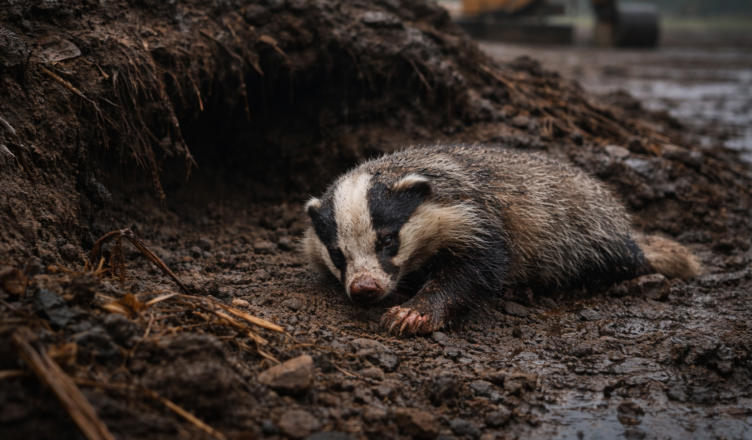
They found the badger at the edge of the construction site, where the earth had been split open and left raw.
His den was gone.
What remained was a shallow pit filled with broken roots and crushed soil, the entrance collapsed like a mouth that would never open again. The badger himself lay a few feet away, sides heaving, claws caked with dirt and blood. One foreleg bent wrong — not freshly broken, but damaged enough that every movement sent a shudder through his body.
He had been digging.
Long after it stopped working. Long after the pain made it pointless.
The rain had started sometime during the night. Mud streaked his fur, and his nose was worn raw, scraped pink from pushing into soil that refused to move. Around him, the machines slept — yellow and silent — waiting to finish what they had started.
When the rescuer approached, the badger lifted his head and hissed weakly.
It wasn’t a threat. It was habit. Muscle memory from a life where giving up meant dying.
They covered him gently with a towel. He fought for exactly three seconds before his strength ran out. Then he went still, chest fluttering like a trapped bird.
At the wildlife center, the X-rays told the rest of the story.
Crushed nerves in the shoulder. Infection already creeping in. The leg might heal enough to stand — but digging? Fighting? Defending territory?
No.
The vet traced a finger along the image of the broken bone. “He won’t survive a winter out there,” she said softly. “Not like this.”
They gave him time anyway.
Pain relief. Food placed close enough that he didn’t have to move much. A quiet enclosure filled with soft earth, deep enough to burrow if he could.
Every night, he tried.
He dragged himself forward inch by inch, claws working automatically, scraping at the dirt with the same stubborn rhythm he’d used at the construction site. His body shook. His breathing rasped. Still, he dug.
On the fourth night, he stopped halfway in.
His head rested against the soil, nose pressed into the cool darkness he couldn’t quite reach. The rescuer knelt beside him, hand hovering — not touching, just there.
“You don’t have to anymore,” she whispered, though she knew he wouldn’t understand the words.
What he understood was warmth. Stillness. The absence of pain for the first time in days.
When morning came, the badger was gone.
His claws were still dirty. His body half-curled, as if sleep had finally taken him in the middle of the thing he wanted most.
He never got his den back.
But he didn’t die alone on broken ground, digging for a home that was already lost.
And sometimes, that’s the difference between surviving… and being spared.