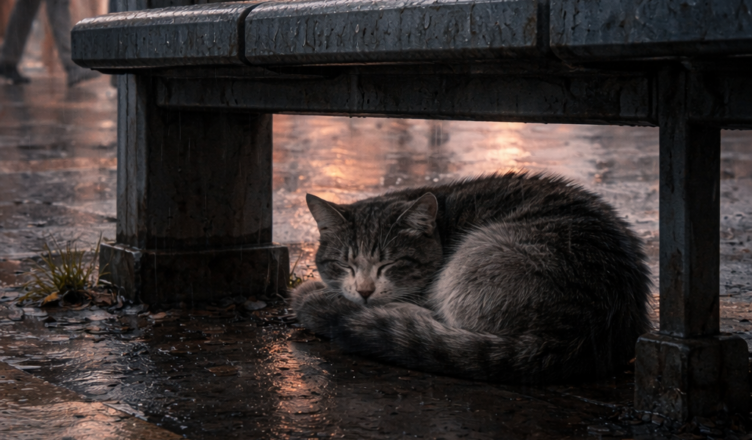
No one knew where she came from.
She appeared one rainy afternoon beneath a bus stop bench on the edge of town, curled so tightly she looked like a shadow folded into itself. Her fur was gray and white, once fluffy, now matted and thin. She didn’t meow. She didn’t run. She simply stayed there—day after day—as people’s shoes splashed past her.
Commuters noticed her in pieces.
“She’s always there,” someone said.
“She must belong to someone nearby.”
“She’ll leave when it gets warmer.”
But the days grew colder instead.
Every morning, she was still there, tucked against the concrete pillar, eyes half-closed, tail wrapped around her body as if trying to hold herself together. When buses arrived, the wind pushed rain under the bench, soaking her fur. She never moved away—only pressed closer to the ground.
A Quiet Detail
Maya was the first to notice what others missed.
She rode the same bus every day to her shift at the bakery. At first, she only saw the cat as a blur beneath the bench. Then she noticed how the cat flinched when people came too close. How one ear was bent strangely. How she never stood fully upright.
One morning, Maya crouched down.
The cat didn’t hiss.
Didn’t swipe.
She just looked up with tired, amber eyes—and slowly closed them again.
That’s when Maya saw the tremble.
The First Offering
The next day, Maya came back with a paper bag.
Inside was a warm croissant she hadn’t sold, broken into small pieces. She placed it a few steps away and backed off. The cat didn’t move at first. Ten minutes passed. A bus came and went.
Only when Maya stood up to leave did the cat inch forward, eating quickly, nervously, as if afraid the food might disappear if she wasn’t fast enough.
Maya smiled—and left.
She did that every day.
Food. Distance. Patience.
Trust, built quietly.
When the Snow Came
The first snow fell early that year.
It gathered on the bench, dusted the sidewalk, melted into icy puddles beneath passing feet. The cat’s fur stayed damp now. Her shivering never stopped.
That morning, Maya brought a towel.
She laid it beneath the bench and waited. The cat watched her hands closely. When Maya stepped back, the cat slowly shifted onto the towel, curling up again, smaller than before.
That was when Maya made a decision she couldn’t undo.
She reached out.
The cat didn’t run.
She didn’t fight.
She simply let herself be lifted, light as a breath, and pressed her face weakly into Maya’s coat.
Healing Isn’t Loud
At the clinic, the truth came gently.
The cat was older than she looked. Malnourished. Dehydrated. Her hip had been injured long ago and never healed right. She’d learned to live with the pain by staying still.
“She’s been surviving,” the vet said. “But she’s exhausted.”
Maya named her Luna.
The first nights at home, Luna hid behind the washing machine. She came out only to eat, always watching, always ready to retreat. Sometimes she cried softly at night—not loudly, just enough to be heard.
Maya slept on the floor nearby.
Slowly, Luna came closer.
First to the doorway.
Then the rug.
Then, one evening, onto the couch—where she fell asleep against Maya’s leg, purring like she was reminding herself how to breathe.
A Different Kind of Waiting
Spring returned.
The bus stop stayed busy. People hurried. Life moved.
But beneath the bench, there was nothing there anymore.
Luna now waited somewhere else.
Every afternoon, she sat on the windowsill of Maya’s apartment, watching the street below. Not for buses. Not for people who never came back.
She waited for a familiar sound—the key in the door.
And when it came, she stood, tail lifting, eyes bright.
She had spent a long time learning how to disappear.
Now, she was learning how to stay.