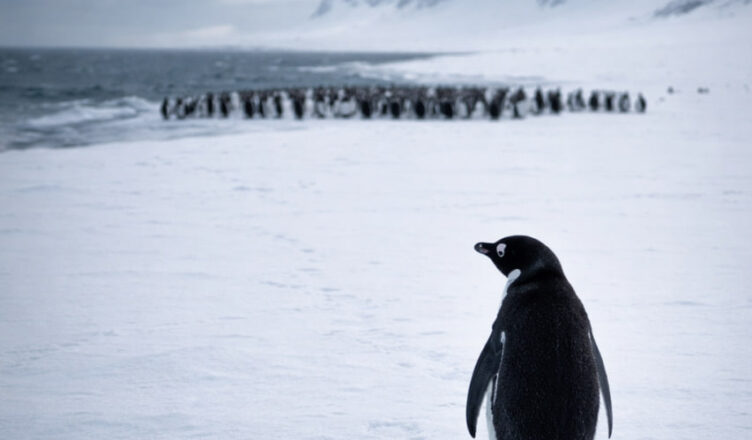
In Antarctica, survival is not a choice.
It is a routine.
The penguins emerge from the sea together. They march together. They return together. The colony moves like a single organism, bound by instinct older than memory. To deviate is to vanish.
And yet, there is the moment when it happens.
A penguin slows.
At first, no one notices. The group continues toward the ocean, toward food, toward repetition. But this one stops. Not in panic. Not in confusion. Simply… stops.
Someone off-camera asks the obvious question—the only question humans ever ask in the presence of meaninglessness:
“But why?”
There is no answer.
The penguin turns its body inland, toward the interior of the continent. Toward a place where nothing lives. Where even bacteria hesitate. Where the cold is not dramatic, but absolute.
Before walking on, it pauses.
For a brief second, it looks back.
Not as if searching for help.
Not as if asking permission.
It looks back as though acknowledging the colony—
and then acknowledging that it no longer belongs to it.
This is the most disturbing part.
Because here, it does not appear lost.
It appears decided.
The penguin takes a step. Then another. The distance grows. The calls from the colony dissolve into wind. The horizon offers no features, no promise, no destination. Only an endless white that erases intention.
It keeps walking.
At a certain point, survival instincts should intervene. But they do not. Biology offers no correction. The animal moves past the invisible boundary where life usually turns back.
And eventually, it collapses.
There is no struggle.
No climax.
No redemption.
The penguin dies where nothing observes it.
⸻
The Moral — As Herzog Implies
Herzog does not explain this moment away.
He does not soften it with science or sentiment.
The question “why?” remains unanswered—not because we lack information, but because the question itself is misplaced.
Herzog’s moral is this:
Not everything that exists is obligated to make sense.
We want to believe that:
• life always seeks continuation
• nature is rational
• deviation must have a purpose
But the penguin shatters this belief.
Its pause—its look back—is what haunts us. Because it resembles choice. And yet, Herzog suggests that even this resemblance may be an illusion. A projection of our own desperation for meaning.
The universe does not explain itself.
It does not justify its errors.
It does not correct every deviation.
Sometimes, something simply walks away.
🧊🐧