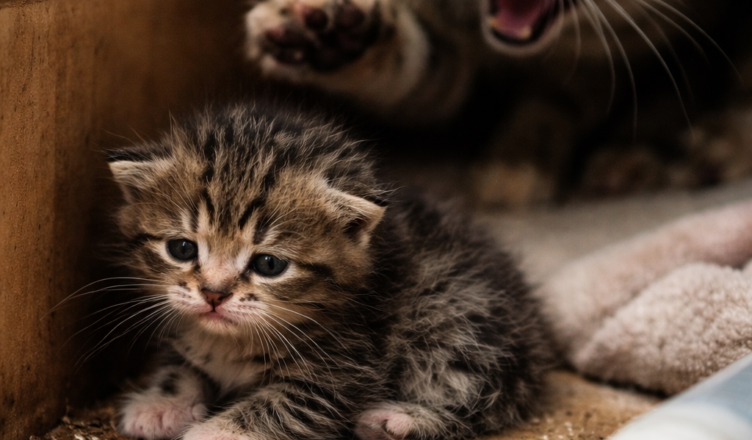
The kitten was no bigger than a hand.
She lay in the corner of the cardboard box, eyes barely open, her tiny chest rising and falling too fast—as if the world itself frightened her. When she tried to crawl toward her mother, she made a small, hopeful sound.
The response was instant.
A sharp hiss cut through the room.
The mother cat arched her back, ears flattened, teeth bared—not in fear, but warning. She swatted the air inches from the kitten’s face.
Everyone froze.
“She’s going to hurt her,” someone whispered.
The kitten stopped moving. She didn’t cry. She simply curled in on herself, as if she already understood she wasn’t wanted.
When Instinct Breaks
The mother cat had been rescued only days earlier—thin, exhausted, still trembling from life on the street. She had given birth in a cold shed, alone. By the time volunteers found her, she was weak, dehydrated, and overwhelmed.
They brought her and the kittens inside, believing safety would be enough.
But one kitten was different.
Smaller. Quieter. Slower to latch.
And somehow… wrong, in the mother’s eyes.
Every time the kitten crawled close, the mother hissed. Growled. Turned away. Once, she tried to push the kitten out of the nest entirely.
It wasn’t cruelty.
It was fear.
Stress can twist instinct. Hunger, pain, exhaustion—they don’t disappear just because walls replace the street.
Choosing Not to Give Up
The volunteers didn’t separate them—not yet.
Instead, they intervened gently.
They fed the mother first. Slowly. Consistently. They gave her space. Soft bedding. Warmth. Quiet. Someone stayed nearby at all times, watching, ready to step in if things turned dangerous.
The kitten was bottle-fed when needed, but always placed back nearby—never taken away completely.
At first, the mother ignored her.
Then, one night, something changed.
The Smallest Shift
The kitten whimpered in her sleep.
Not loud. Not desperate.
Just a sound.
The mother cat lifted her head.
She didn’t hiss.
She didn’t move closer either—but she listened.
The next feeding, the mother didn’t swat when the kitten crawled near. She simply turned her head away. That alone felt like progress.
Over the next days, the hissing softened. Became shorter. Less sharp. More uncertain.
One evening, as the kitten slept pressed against the warm blanket, the mother cat leaned forward—just a little—and sniffed her.
The room went silent.
Then, almost reluctantly, the mother began to groom the kitten’s head. One lick. Then another.
As if reminding herself who this tiny life belonged to.
Learning Each Other Again
It wasn’t instant. There were setbacks. Moments of tension. Times when the mother walked away.
But the kitten grew stronger.
And as she did, the mother relaxed.
Soon, the kitten nursed without fear. Slept against her mother’s belly. Purred—soft and unsteady, but real.
The mother cat watched her constantly now. Protective. Alert. Fierce in a different way.
The hissing stopped.
What Love Sometimes Needs
People like to believe love is automatic.
But sometimes—even in animals—love needs help.
It needs safety. Patience. Time. Someone willing to stand nearby and believe that broken instincts can heal.
Today, the mother cat curls her body around her kitten like a shield. The kitten climbs over her siblings, fearless, certain she belongs.
No one hisses anymore.
No one is afraid.
And the kitten who was once rejected now sleeps to the sound of her mother’s steady heartbeat—exactly where she was always meant to be.