Naomi Carter was halfway through her shift when the coins hit the conveyor belt.
Not tossed—placed carefully, one by one, like the person counting them was trying not to make a sound.
The grocery store was the kind of place that never truly slept. Fluorescent lights buzzed softly overhead. The floor smelled faintly of lemon cleaner. Outside, rain tapped the windows in a steady rhythm that made the world feel farther away than it was.
Naomi had been on register three since 3 p.m. and her feet had stopped being feet hours ago. They were just… pain. She’d learned to smile anyway.
“Hi there,” she said automatically.
A small boy stood on the other side of the belt, maybe six years old, wearing a hoodie that was too thin for the weather. His hair was damp at the edges like he’d been outside for a while. He stared at the candy bars stacked by the register with the seriousness of someone deciding whether hope was allowed.
Beside him stood an older woman with gray hair pulled into a low bun. Her hands shook as she counted. Not from age exactly—something else. Something shaky inside her.
On the belt: a loaf of bread, a jar of peanut butter, a single banana, and a small carton of milk.
Then the coins.
Naomi watched the woman’s lips move as she counted under her breath.
“Thirty-seven… forty-two… forty-six…”
She paused at the milk and glanced at the total on the screen like it was a verdict.
Naomi waited. Customers were lined up behind them, shifting, sighing, scrolling their phones. The store’s music played something upbeat that felt almost cruel.
The woman cleared her throat. “Could we… could we put the milk back?”
The boy’s eyes flicked to the carton. He didn’t protest. He didn’t pout.
He just got very still.
Naomi had seen hunger before. She’d grown up with it brushing against the edges of her life like a stray cat. But the kind that shows up in a grocery store—quiet, polite, trying not to bother anyone—that kind always hit harder.
Naomi’s chest tightened.
She looked at the woman’s hands. The nails were clean. The coat was old but cared for. This wasn’t someone who didn’t try.
This was someone who was running out.
Naomi made a decision before her brain had time to argue with it.
She reached under the counter, pretending to adjust something, and quickly typed a code she wasn’t supposed to use unless the manager approved.
A small discount flashed.
Then she scanned the milk again, as if it had never been in question.
“That’s okay,” Naomi said lightly, keeping her voice normal. “Looks like the system applied a store promo. It happens sometimes.”
The woman blinked, confused. “It did?”
Naomi smiled like it was the most ordinary thing in the world.
“Mhm. Your total is $8.12.”
The woman stared at the screen, then at her coins, then back at Naomi.
Her eyes watered fast, like her emotions had been waiting behind a door for the slightest crack.
“Oh,” she whispered. “Oh honey…”
The boy looked up at Naomi then—not at the candy, not at the coins.
At her.
Like he was memorizing her face.
The woman pushed the coins forward with trembling fingers. “Thank you,” she said, barely audible.
Naomi scooped the coins into the drawer and quickly bagged the groceries.
The boy reached into his pocket and pulled out something small and plastic: a tiny red keychain shaped like a firetruck, scratched and worn.
He held it out.
Naomi blinked. “Oh no, sweetie—keep that.”
The boy shook his head, stubbornly gentle.
“He said… the person who helps is supposed to have it,” the boy murmured.
“Who said?” Naomi asked softly.
The boy hesitated, then shrugged like he didn’t want to get anyone in trouble. “My dad.”
Something in Naomi’s throat tightened.
She took the little firetruck keychain carefully, like it mattered.
“Tell your dad,” she said, trying to keep her voice steady, “that he raised a very brave kid.”
The boy’s mouth twitched—almost a smile.
The older woman took the bag, and they started to leave.
But before they stepped away, the boy turned back.
He reached into the bag and pulled out a receipt Naomi had tucked inside.
On the back of it—already scribbled in pencil—was a drawing.
Stick figures: a tall person, a small person, and what looked like… a big bridge with lines underneath. Water? Tracks? Naomi couldn’t tell.
At the top, in shaky letters:
SAFE PLACE
Then the boy ran to catch up with the woman, their figures disappearing through the automatic doors into rain.
Naomi held the receipt for a second too long.
Then she folded it and slipped it into her apron pocket next to the firetruck.
And she went back to scanning groceries like her heart hadn’t just cracked open at register three.
Two hours later, the front doors opened again.
But this time, the sound of the bell wasn’t casual.
It was sharp.
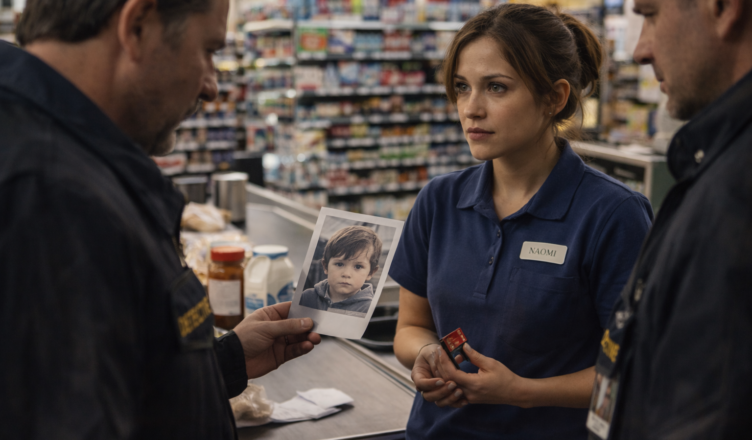
Naomi looked up and saw two detectives step inside, rain beading on their jackets. One of them had that exhausted look people get when they’ve been running on adrenaline and coffee for too long.
They didn’t wander.
They walked straight toward register three.
Naomi’s hands went cold.
The taller detective stopped at the counter. “Ma’am, can we speak with you?”
Naomi’s voice came out smaller than she meant. “Is… is something wrong?”
The detective pulled out a photo—freshly printed, edges still stiff.
It was the boy.
Same damp hair. Same hoodie. Same serious eyes.
Naomi felt her stomach drop as if the floor tilted.
“We’re looking for him,” the detective said. “His name is Eli Bennett. Have you seen this child?”
Naomi’s mouth opened, but nothing came out at first.
“Yes,” she managed. “He was here. He—he just left. With a woman.”
The second detective leaned in. “What woman?”
Naomi swallowed hard. “Older. Gray hair. Coat. She… she seemed confused. But she wasn’t… she wasn’t violent or anything. She paid with coins.”
The taller detective’s jaw tightened. “Eli’s been missing since this afternoon. There was a multi-car accident on the interstate. His father was transported to the hospital with injuries. Eli was in the backseat. When first responders arrived, the child was gone.”
Naomi’s head spun.
“Gone?” she repeated, as if saying it differently might make it less real. “But he was… he was right here.”
The detective nodded, eyes serious. “Do you know where they went?”
Naomi shook her head quickly. “No. I didn’t—he didn’t say.”
The second detective glanced past Naomi toward the exit, then back. “Did he look hurt?”
Naomi thought fast, scanning her memory like a rewind. “No blood. He looked cold. Wet. Tired.”
The taller detective’s gaze dropped to Naomi’s apron pocket, where something red peeked out.
“What’s that?” he asked.
Naomi’s fingers moved without permission. She pulled out the firetruck keychain.
The detectives stared.
The taller one exhaled slowly. “His father is a firefighter,” he said quietly. “That keychain… that’s from their station. It has their emblem.”
Naomi’s throat closed.
“I didn’t—he gave it to me,” she said quickly. “He said his dad told him to give it to the person who helps.”
The detective’s face softened for a brief second, then hardened again with urgency.
“Did he give you anything else?” the detective asked. “Anything he said? Any clue at all?”
Naomi’s hand flew to her apron pocket.
The receipt.
Her fingers shook as she unfolded it.
The detectives leaned in as Naomi revealed the drawing: the bridge, the lines underneath, the stick figures.
And the words:
SAFE PLACE
The taller detective stared at the bridge. “Did he mention a bridge?”
Naomi’s mind flashed back to the boy’s calm voice.
No. Not directly.
But then she remembered something she hadn’t thought mattered: the boy, looking past her shoulder at the poster near the entrance advertising a local event.
RIVERWALK BRIDGE FESTIVAL – THIS WEEKEND
Eli had stared at that poster.
A long time.
Naomi’s heart hammered.
“He kept looking at the Riverwalk poster,” Naomi said. “Like he knew it. Like he was… trying to remember.”
The detectives exchanged a look.
“Riverwalk Bridge,” the taller one repeated. “There’s a pedestrian bridge near the old rail line.”
Naomi’s breath caught.
The lines under the bridge in the drawing—tracks.
Not water.
Tracks.
The second detective stepped back, already reaching for his radio. “Dispatch, we may have a location…”
Naomi’s voice cracked. “Is he… is he in danger?”
The taller detective met her eyes. “He’s a child alone in the rain. That’s danger enough. But you just gave us a direction.”
He glanced at the firetruck keychain in her hand.
“And you gave him something else,” he added quietly. “You gave him a reason to keep trusting people.”
Naomi didn’t feel heroic.
She felt sick with fear.
They found Eli at Riverwalk Bridge.
Not on the bridge itself—but under it, tucked near the concrete supports where the wind was quieter.
The older woman was there too, sitting against the wall, head tipped back, eyes half-closed like she’d run out of strength. Her hands were still curled as if she’d been counting coins even in her sleep.
Eli sat beside her, small arms wrapped around his knees, the grocery bag pressed to his chest.
When the detectives approached, Eli flinched at first—until he saw the firetruck emblem on one of their jackets.
Then he stood up so fast he nearly fell.
“Is my dad okay?” he blurted, voice breaking.
The detectives crouched to his level.
“He’s hurt,” the taller detective said gently, “but he’s alive. He’s been looking for you.”
Eli’s face crumpled. He tried not to cry. He tried hard.
Naomi wasn’t there in person, but she heard the story later from a cashier who watched the news that night.
Eli explained in a shaky rush that after the accident, he’d gotten out and wandered because everything was loud and scary and people were yelling and someone had grabbed him and he didn’t know if they were safe. He ran until he couldn’t breathe.
The older woman—her name was Marjorie—had found him near a bus stop. She wasn’t a kidnapper. She wasn’t evil.
She was disoriented, struggling with early dementia, convinced she was “taking her grandson home.”
But her home didn’t exist anymore.
She’d carried him as far as her mind could manage until her body gave out.
And in the middle of all that, a six-year-old boy had done the only thing he could think of:
He found a place he believed was a “safe place.”
Because a cashier in a grocery store had treated him like he mattered.
Later that night, when Naomi finally clocked out, her phone had three missed calls from an unknown number.
Then a voicemail.
A man’s voice, rough with pain and emotion.
“Hi… this is Miles Bennett. Eli’s dad. The detective gave me your number. I’m calling from the hospital.”
A pause. A breath that sounded like he was trying not to fall apart.
“I don’t know how to thank you. Eli told me about you. He said you… you made it feel safe for him to be a kid again for a minute.”
Naomi sank onto the bench outside the employee entrance, rain misting her hair.
“I’m sorry,” the voice continued. “I can barely sit up. But I needed you to hear this.”
Another pause.
“He gave you my station keychain,” Miles said, voice cracking. “That belonged to my dad. He passed last year. Eli only gives it away when he thinks someone is… truly good.”
Naomi pressed a hand to her mouth.
“I owe you,” Miles finished softly. “Not money. Not like that. I just… I owe you. Thank you for being his safe place.”
Naomi listened to the voicemail twice.
Then she held the tiny red firetruck keychain in her palm until her fingers warmed it.
A week later, the grocery store manager called Naomi into the office, and Naomi’s stomach dropped—because she assumed she was finally being punished for that discount code.
Instead, the manager slid a paper across the desk.
A new sign for the entrance, professionally printed.
SAFE PLACE SHELF
If you can, leave a nonperishable item. If you need, take what you need. No questions.
The manager cleared his throat, looking uncomfortable with sincerity.
“The community started donating after the story went around,” he said. “Eli’s dad… the fire department… they showed up with three boxes yesterday. Someone said you started it.”
Naomi blinked. “I didn’t start anything.”
The manager shrugged. “You did something. And people noticed.”
That afternoon, Naomi taped Eli’s crumpled drawing behind the register.
Not for attention.
For herself.
A reminder that sometimes the smallest choice—keeping milk on the belt, pretending a “promo” exists—can become the hinge a whole life swings on.
Because it wasn’t the groceries that saved Eli.
It was the feeling that a stranger could be kind without wanting something in return.
If this story hit you, share it.
Somewhere, a kid is counting coins in a line that’s too long, in a world that’s too loud, trying to stay brave.
And sometimes all it takes is one person—one quiet “it’s okay”—to become their safe place.