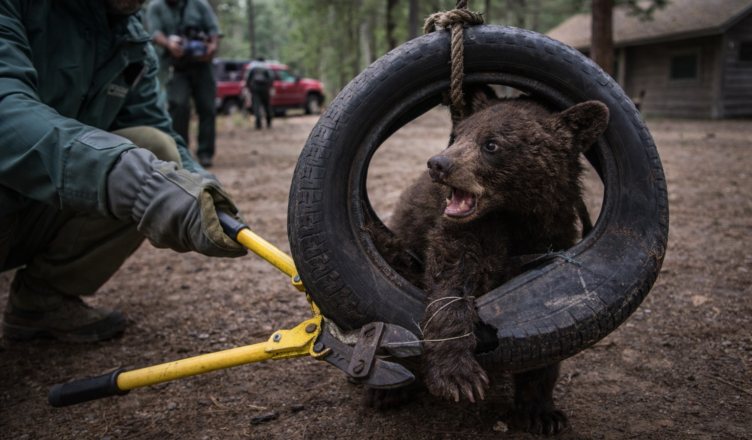
The summer camp was supposed to be empty.
That was the whole point—off-season silence, cabins locked, the lake still, the ropes course hanging unused between trees. The caretaker, Wes, only came by twice a week to check for storm damage and keep raccoons from turning the mess hall into a buffet.
So when he saw movement near the playground, his first thought was teenagers.
His second thought—when the “teenager” stood up and he saw fur—was to stop breathing.
A bear cub.
Not tiny, but young enough to have that awkward, long-limbed look. It was standing beneath the tire swing, head lowered, shoulders heaving.
And the tire was… wrong.
The cub’s head was through the center of it, but the tire wasn’t around its neck like it should’ve been.
It was jammed over one shoulder and across its chest, twisted at an angle that pinned one front leg tight to its body. Every time the cub tried to pull back, the tire bit deeper into fur and muscle, trapping it more. The rope above creaked under strain as the cub thrashed.
Then the cub made a sound that snapped Wes’s heart in half.
A thin, frantic bawl—high like a child calling for its mother.
Wes froze behind a tree.
Because if the mother bear was nearby, this could go from rescue to funeral in seconds.
He backed away slowly and called wildlife services with shaking fingers, whispering into the phone like the forest could hear him.
“There’s a cub stuck in a tire swing,” he said. “Please. Please hurry.”
While he waited, he kept eyes on the clearing from a distance. The cub’s movements got weaker over time—panic burning itself out. It stopped thrashing and just stood there, chest pumping, tire dragging its body downward like a weight.
Then, worst of all, it tried to lie down.
It couldn’t.
The tire forced it into a twisted half-sit, one leg trapped, breathing fast, eyes wide and glassy.
Wes watched the tree line, praying the mother bear wouldn’t appear and make everything worse.
When the rescue team arrived, they came with a truck, tranquilizer gear, and bolt cutters large enough to cut metal. They moved fast but careful, scanning for the mother.
The lead biologist raised a hand at Wes. “Stay back. Way back.”
Wes nodded, throat tight, and stepped behind the truck.
The dart was clean.
The cub jolted, took two stumbling steps, and then sank onto the dirt, tire thumping softly beside it. Even sedated, its body twitched as if it was still trying to escape.
The rescuers moved in immediately, draping a tarp for shade and lowering their voices. They examined the cub’s shoulder where the tire had been digging in.
Raw fur. Swollen skin. Deep grooves. Not fatal yet, but bad enough that another day could’ve meant circulation loss. Nerve damage. A slow death from injury and hunger.
They tried to slide the tire off first.
It wouldn’t budge.
The cub’s body had swollen around it.
“Cut it,” the biologist said.
The bolt cutters snapped through rubber with a harsh crunch. Once. Twice. Three times. The tire finally opened like a black jaw releasing its bite.
The cub’s trapped leg fell free.
It twitched weakly.
One rescuer checked the paw and exhaled. “Warm. Good sign.”
They cleaned the abrasions quickly and injected antibiotics. They checked breathing, heart rate, temperature. Then they dragged the ruined tire away from the cub like it was a crime scene.
As the sedative began to wear off, they backed away and watched from the truck.
The cub stirred.
Head lifting slowly, confused. One paw scraping the dirt. Then it tried to stand and wobbled, weight shifting awkwardly because pain makes everything unfamiliar.
It looked around wildly, sniffing the air.
And then it made that sound again.
A smaller, weaker bawl.
Calling.
The forest answered.
A heavy shape moved between trees—silent, enormous.
The mother bear stepped into view.
Wes’s blood went cold.
The rescuers didn’t move. They didn’t shout. They didn’t raise weapons. They stayed still and let the mother read the scene in her own language.
The mother bear’s nose lifted. She sniffed the air—human, rubber, sedative, fear.
Then she locked eyes on her cub.
The cub stumbled toward her, limping, bawling again, smaller now, like the call was breaking from exhaustion.
The mother closed the distance in three powerful steps and pressed her head against the cub’s side, sniffing hard, checking, counting injuries.
Then she did something that made every person in that truck exhale at the same time:
She turned her body slightly—placing herself between the cub and the humans.
Not charging. Not attacking.
Shielding.
The cub leaned into her and went quiet.
The mother bear stared at the truck for a long moment, black eyes unreadable.
Then she nudged the cub forward.
They moved together—slow at first, then faster—disappearing into the trees as if the clearing had never held panic at all.
Only the tire swing rope still swayed gently in the empty air.
Wes stood behind the truck long after they were gone, hands shaking, staring at the cut tire lying in the dirt like a shed skin.
Because the truth hit him in a wave:
That cub had been calling all night.
Not for help.
For its mother.
And somehow—by luck, by timing, by humans finally seeing the danger they’d built—
the cub lived long enough for her to find it again.