It was the kind of morning fishermen remember for the wrong reasons.
The sea was too calm—flat like glass, sound traveling farther than it should. A thin fog sat on the horizon, blurring boats into shadows. When the first call came over the radio—“Something big near the kelp line, not moving right”—everyone assumed it was driftwood.
Then they got closer.
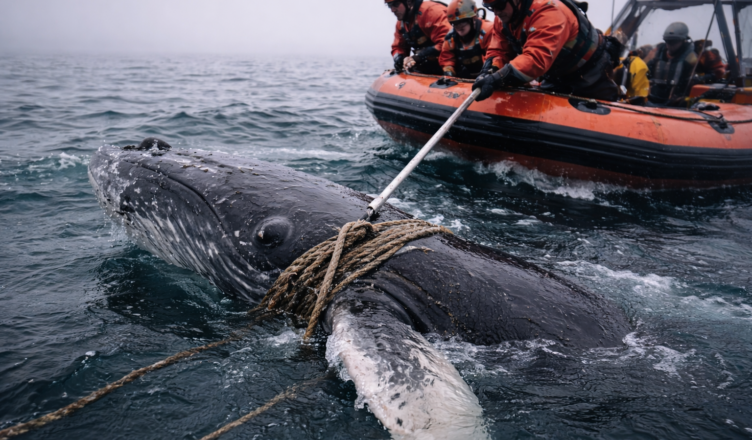
A juvenile humpback floated just offshore, body angled oddly, blowhole barely breaking the surface. Every few minutes it exhaled, a soft burst of mist, then went still again. No dive. No roll. No powerful sweep of tail.
Just… waiting.
The captain cut the engine and the boat drifted. In the silence, they heard the sound that made the hairs on his arms rise.
A faint, rhythmic scraping.
Line.
The whale’s left pectoral fin was wrapped in it—thick rope and thinner cord braided together like a trap that had been building itself. It crossed the fin, ran under the belly, and disappeared into the green darkness below where something heavy tugged back.
A buoy. A crab pot. A piece of gear the ocean didn’t forgive.
Each time the whale tried to move, the rope tightened. You could see it bite into skin, creating a shallow groove that looked like a cruel smile across the fin. The whale didn’t thrash. It didn’t panic.
That was the scariest part.
It had already learned that fighting made it worse.
The captain called the disentanglement hotline and kept his boat nearby—not crowding, not chasing—just staying close enough that when help arrived, the whale would still be there.
The response team came fast: a rigid inflatable, bright orange dry suits, long poles with hooks and blades. Everyone moved with the careful urgency of people who know one mistake can kill both sides.
The whale watched them.
Not in a human way. But with awareness. With a stillness that felt like intelligence.
They approached from the side, keeping clear of the tail. One rescuer leaned forward with a pole and snagged a loose line near the fin. The moment it tightened, the whale flinched and surged forward—sudden power, instinct overriding caution.
The rope snapped taut.
The whale’s body jerked back as if the ocean itself had yanked it.
It let out a low sound—not a song, not a call—something heavy and unhappy that vibrated through the water and into the boat hull.
The rescuers backed off and waited.
You don’t force a whale to trust you. You earn it by not being the next pain.
Minutes passed. The whale drifted again, breathing slower, the surface of the ocean smoothing back over like nothing happened.
Then the team tried a different angle—cutting the highest tension points first. Small cuts. Quick releases. Each slice eased the pressure by a fraction, like loosening a tourniquet that had been tightening for days.
A rope strand snapped free and floated up, limp like seaweed.
The whale exhaled hard.
It still didn’t dive.
It couldn’t.
Whatever was under it—the gear, the weight—still held.
The lead rescuer changed tools: a longer pole, a blade designed to cut clean through thick line. He leaned out again, eyes fixed, hands steady.
One more cut.
The rope under the belly parted.
For a heartbeat, nothing moved.
Then the hidden weight below released, and the whale surged forward—not frantic, not violent, just suddenly able.
It rolled once, slow and deliberate, as if testing its own freedom.
And then it dove.
Not shallow.
Not hesitant.
A real dive—the kind that says I remember who I am.
The tail lifted, massive and dripping, and vanished into the gray water, leaving only foam and a widening circle of calm.
The ocean went quiet again.
On the boat, nobody spoke for a long moment. The captain realized his hands were shaking. One rescuer wiped his face with the back of his glove like he was embarrassed to be human about it.
Then, far out near the fog line, a blow appeared again.
Once.
Twice.
The whale surfaced at a distance—just long enough to breathe—then sank smoothly beneath the surface, as if it had decided the story was finished.
The boat turned back toward shore.
A handful of severed rope lay coiled on deck, wet and heavy, like proof you could hold in your hands.
Not proof that humans had saved a whale.
Proof that for a few minutes, we stopped being the reason it was dying.