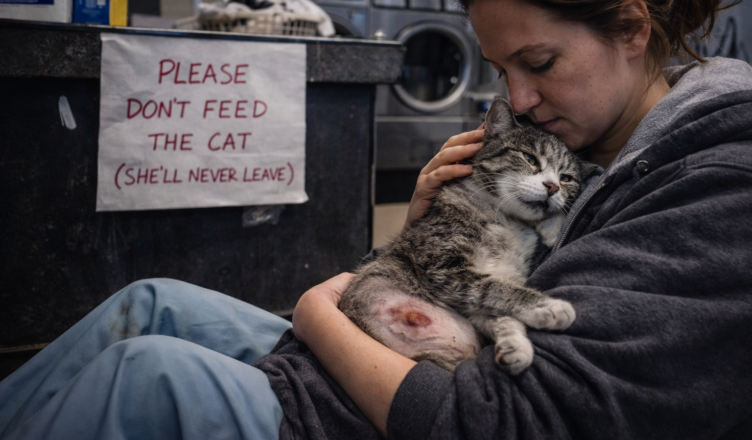
She appeared in the laundromat like she belonged to it.
Not bold—just certain. A small gray cat with a torn ear and a tail that kinked near the tip, slipping through the door whenever someone held it open too long. She’d weave between ankles, jump onto the warm dryer, and curl up as if the rumbling was hers.
Nobody claimed her.
The owner didn’t chase her out, either. He just taped a hand-written sign to the counter:
PLEASE DON’T FEED THE CAT (SHE’LL NEVER LEAVE)
Of course, people fed her anyway.
A piece of chicken from a takeout box. A corner of a tuna sandwich. Someone even brought kibble in a plastic baggie and pretended it was an accident when it spilled “near” the back wall.
She never begged.
She simply waited, head lowered, eyes half-closed, like she was conserving energy for something more important than charm.
That was how Lena noticed something was wrong.
Lena came in every Thursday night with a basket of uniforms from the hospital and a brain too tired to do anything except count quarters. The cat was always there, always on the same dryer, always watching the door like she was keeping time.
But one night, the cat didn’t jump up.
She stayed on the floor near the utility closet, sitting in a tight loaf position that looked like calm—until Lena saw the trembling.
Not fear trembling. Pain trembling.
When Lena crouched, the cat’s breathing was too fast. Her eyes were glassy. She licked her side in short, frantic bursts, then stopped, panting, like licking hurt too much to finish the thought.
Lena gently slid her fingers under the cat’s belly to check for injury.
The cat didn’t scratch.
She just went rigid.
And Lena felt it—hot, swollen skin beneath fur. A lump, firm and wrong, low on the abdomen. The kind of thing you learn to recognize if you work around medicine long enough.
Abscess.
Probably from a fight. Probably from a bite that had sealed over on the outside while it rotted underneath.
The cat tried to stand and couldn’t do it cleanly. One back leg wobbled, and she sat back down hard, blinking slowly as if she could blink the pain away.
Lena swallowed and looked around the laundromat.
A teenager was folding towels. An old man was watching a soap opera on his phone. The owner was behind the counter, counting change.
Everyone was living their normal lives.
And this cat—this cat who didn’t live there—was quietly dying on tile.
Lena took off her hoodie and laid it on the floor like a blanket.
The cat didn’t move onto it at first.
Then, after a long minute, she dragged herself forward and pressed her cheek into the fabric like she was marking it, claiming it, saying okay… okay… I’ll take this help if it’s real.
“Alright,” Lena whispered. “Alright, baby. We’re going.”
She called an emergency vet and warned them she was coming with a stray. Then she did the hardest part: she reached for the cat with purpose.
The cat hissed once—a weak, embarrassed sound—and then let Lena scoop her up.
Her body was too light.
That was the second thing that made Lena’s stomach drop.
At the clinic, they didn’t waste time.
The vet shaved a patch of fur and the truth revealed itself immediately: the skin was stretched tight and shiny, and a tiny puncture hole hid in the center like a secret.
When they lanced it, the abscess released with a wet, awful sound, and the cat’s whole body shuddered with relief so intense it looked like grief.
They flushed it. Drained it. Packed it. Antibiotics. Pain meds. Hydration.
The vet glanced up at Lena. “If you’d waited another day or two… she might’ve gone septic.”
Lena nodded once, jaw clenched. She didn’t trust her voice.
Back at home, Lena set the cat up in her bathroom with a low litter box, a towel nest, and a heating pad on low. The cat slept for hours, heavy and deep, the kind of sleep animals only allow when they finally believe they won’t be punished for closing their eyes.
When she woke up, she limped to the water bowl, drank, and then—without asking permission—climbed into Lena’s lap like she’d been doing it forever.
She pressed her forehead to Lena’s stomach and stayed there.
Not purring.
Not performing.
Just holding still—like this was the only safe place she trusted.
Lena stroked the cat’s head gently, feeling the jagged edge of the torn ear, the thin bones under fur, the warmth returning.
“You don’t live at the laundromat,” Lena whispered.
The cat blinked slowly.
And then, for the first time, she purred—quiet and broken, like an engine coughing back to life.
Two weeks later, Lena walked into the laundromat to pick up the last of her uniforms.
The sign was still on the counter.
PLEASE DON’T FEED THE CAT (SHE’LL NEVER LEAVE)
Lena peeled it down carefully and folded it in half.
The owner looked up. “Where’d she go?”
Lena looked at him for a second, then smiled the smallest smile.
“Home,” she said.
And for once, that word meant exactly what it was supposed to mean.