They thought it was just sleeping.
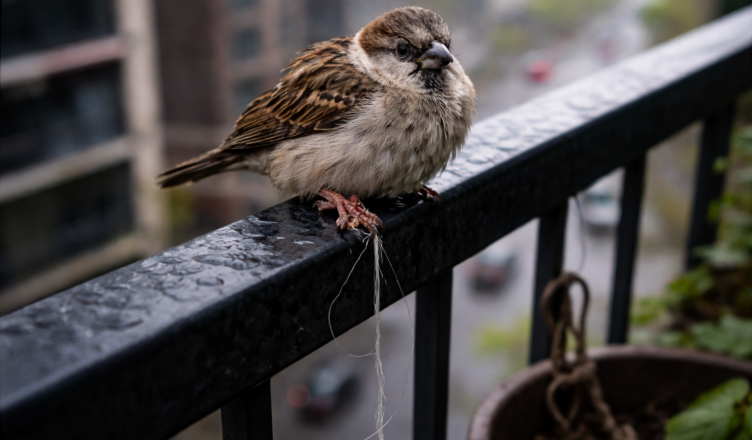
A small sparrow, puffed up against the cold, perched on the balcony rail like a forgotten ornament. Morning light hit its feathers and made them look soft, almost warm. The city below was already loud—buses sighing, doors slamming, voices bouncing between buildings.
But the sparrow didn’t flinch.
It didn’t turn its head. It didn’t blink the way birds usually do—quick, sharp, constantly alert.
When the woman stepped closer, she saw the thread.
A long, pale strand—fishing line or packaging string—wrapped around the bird’s leg, then again, then again. It dug so deep the skin had swollen around it, turning the tiny limb into something wrong and thick. The string trailed down through the bars of the rail and into a hanging plant pot below, knotted around the metal hook like a cruel little anchor.
The sparrow had tried to fly.
And every time it did, the line yanked it back.
Feathers were stuck to the railing in small tufts, as if the bird had been dragged along the metal. One wing hung slightly lower than the other, trembling in a way that wasn’t from wind.
The woman moved slowly, like she was approaching a bomb.
When she reached out, the sparrow jolted—finally alive—eyes wide, beak opening in a silent panic. It flapped once, twice, the wing scraping the railing, and then the line snapped it back into place.
The bird froze again, panting, chest flickering fast.
The woman’s hands shook as she grabbed scissors from the kitchen.
She draped a towel over the sparrow first. Darkness calmed it a fraction, the way night calms everything that’s too scared to move. Under the towel, she could feel the bird’s heart—tiny and furious, fighting like it still believed it could outpace the damage.
She followed the string with her fingers until she found the tightest loop.
Then she cut.
The tension released instantly. The sparrow sagged into her palm, so light it didn’t feel real. When she peeled the towel back just enough to check, she saw blood where the string had been—thin, bright, shocking against the brown-gray feathers.
She called a wildlife center and drove with one hand on the wheel, the other cupped around the towel like she was carrying something made of breath.
At the center, they unwound the rest.
The leg underneath was raw and swollen. The circulation had been cut off long enough to leave the foot cold and stiff. The vet’s face tightened—just for a moment—before it smoothed back into professional calm.
They could try.
They always tried.
They cleaned the wound. They warmed the bird. They gave antibiotics so small they looked like dust in a syringe. They placed the sparrow in a heated enclosure where the air was quiet and the light was soft.
For a while, it seemed like it might work.
The sparrow stood the next morning, shaky but upright. It pecked once at a seed. Then again. The volunteer exhaled like she’d been holding her breath all night.
That afternoon, the bird attempted to preen.
It lifted the injured leg slightly—instinct, habit, the old ritual of putting yourself back together—and then it stopped, confused, as if the body didn’t recognize its own parts anymore.
That night, it grew quiet.
Not panicked. Not struggling.
Just quiet.
When they found it in the morning, it was curled into the corner of the enclosure, feathers fluffed, head tucked under one wing like it had finally managed to fall asleep.
Only it hadn’t woken up.
The volunteer wrapped it gently in a cloth and stood there longer than she needed to, staring at something so small that had fought so hard. There wasn’t rage in the room. Just a deep, helpless sadness that this is how fragile life is—how a thin piece of string can become fate.
On the balcony rail, back at the apartment, the woman later found one more thing.
A tiny line of feathers caught under the metal bar, stuck there with dried rain.
Proof that the bird had been there.
Proof that it had tried.
And in a world that forgets small tragedies immediately, sometimes proof is the only form of justice we get.