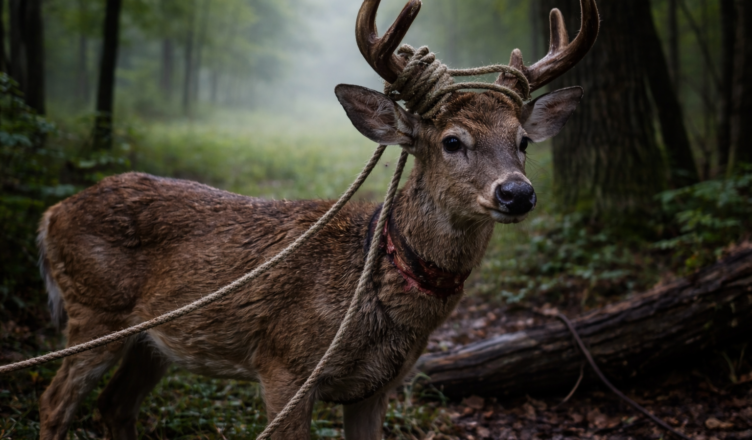
They thought it was a stump at first—something dead and gray caught between trees.
Then it moved.
The young deer stood at the edge of the forest where the undergrowth thinned into a drainage ditch. Fog hung low over the grass, turning everything quiet and unreal. He didn’t run when the hikers appeared. He didn’t even lift his head properly.
Because he couldn’t.
A length of rope was wrapped around his antlers so many times it looked deliberate—tight, ugly loops that dug into velvet and hair. The rope ran down his neck and vanished into the brush behind him, tethered to a fallen branch like a cruel anchor.
Every time he tried to step forward, the rope snapped taut.
His head jerked back hard enough to make his front legs buckle. He would freeze, breathing fast, and then try again—small, careful steps that ended in the same violent pull.
He’d been stuck long enough to learn the pattern.
Don’t fight too hard.
Don’t thrash.
Just wait.
But waiting was killing him anyway.
The rope had rubbed raw patches along his neck. One side of his face was swollen where the rope had dragged his antlers sideways. His eyes were wide and wet, not frantic anymore—just exhausted, like he’d cried without tears for days.
The hikers backed away and called wildlife rescue.
While they waited, they did the only thing they could: stand nearby and keep him calm, making their bodies small, voices softer than the fog.
When the rescuer arrived, she didn’t rush.
She watched the deer’s breathing first. The way his ribs moved too quickly. The way his legs trembled from holding his own head at the wrong angle for too long. She spoke to him like he was a scared child, not because he understood the words, but because the tone said I’m not here to hurt you.
The deer tried to run anyway.
Instinct.
The moment he lunged, the rope yanked him backward so hard his hooves slid out from under him. He hit the ground with a dull thud, and for a second he lay there stunned—eyes blinking, chest heaving, as if his body couldn’t decide which pain to prioritize.
That was the moment the rescuer moved.
A blanket over his head. A hand on his shoulder. Pressure, steady, firm, kind—enough to keep him from thrashing himself into worse damage.
She found the knot where the rope had been tied.
It wasn’t a hunter’s snare. It wasn’t a natural tangle.
It was a human knot.
The cutters bit into the rope, strand by strand. The deer trembled with each snip, as if the sound itself hurt. When the final loop loosened, his head dropped forward abruptly—free weight returning all at once.
He startled, stumbling, then steadied.
And then, for the first time in who knows how long, he lifted his head without being yanked back.
It should have been the happy ending.
But freedom doesn’t erase damage.
When they got him to the clinic, the vet traced the deep grooves in his neck and shook her head slowly. The rope had crushed tissue. Infection had started. The antlers had been pulled so hard they’d strained his skull and neck. He would need weeks of care, maybe longer. Pain management. Monitoring. A quiet place to heal where panic couldn’t finish what the rope started.
That night, sedated and warm, the deer slept on clean straw.
And even asleep, his legs twitched—running in place, like part of him still expected the rope to snap tight and punish him for moving forward.
Days passed.
Swelling went down. Wounds cleaned. Antibiotics worked their slow miracles.
Then one morning, the deer stood—steady, tall, breathing deep—head held high like it belonged to him again.
The rescuer opened the gate to the rehab pen.
He didn’t sprint out.
He walked.
A careful, deliberate walk into the trees, as if he was testing the world for hidden ropes.
At the edge of the forest, he paused and turned once.
Not long. Not dramatic.
Just a quick look back—ears angled forward, eyes calm now, fog lifting off the grass.
Then he disappeared into the green, carrying nothing with him but scars… and the strange, hard-earned knowledge that sometimes, freedom arrives with cutters and hands that don’t let go.