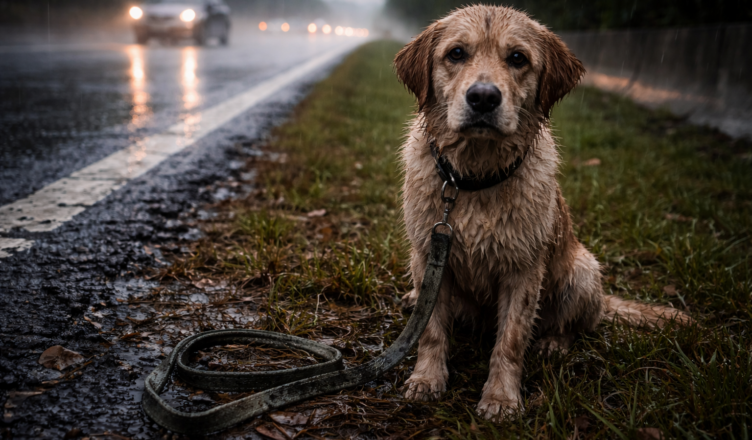
They found the dog sitting in the median where the highway split—like he’d chosen the most dangerous place possible because it was the easiest to see.
Rain misted the asphalt. Headlights made the world strobe. Cars tore past on both sides, wind punching his fur flat against his ribs.
He didn’t move.
A cheap nylon leash lay coiled beside him, still clipped to his collar. The end of it was frayed, wet, and dark, as if it had been yanked free from something that didn’t want to let go.
Every time a vehicle slowed, his ears lifted. His head turned. His tail gave a single, uncertain thump.
Then the car kept going, and the hope drained out of him like water off his coat.
When the state trooper stopped traffic long enough for the volunteer to reach him, the dog didn’t bolt. He didn’t snarl. He didn’t even try to back away.
He just stared at her hands like he was waiting for them to do what hands always did next.
She crouched low, voice soft, rain soaking her sleeves. “Hey, sweetheart. Hey. It’s okay.”
The dog’s eyes flicked to the leash. Then back to her face. Like he was asking the only question he knew how to ask:
Are we leaving now?
She slid a loop of slip lead over his head. His body relaxed so hard it was almost painful to watch. As if the moment the pressure around his neck changed, something inside him finally stopped clenching.
In the van, he sat upright the whole way to the clinic. Not nervous. Not pacing. Just sitting, nose pointed forward, eyes tracking the road like he was expecting a familiar turn.
At intake they scanned for a chip.
Nothing.
They checked his teeth—young. His coat—clean, recently brushed. His paws—raw from running, tiny cuts packed with grit. Along his chest, a purple bruise spread like a shadow, and when the vet pressed gently there, he flinched, silent.
Hit. Or thrown. Or both.
They cleaned him up anyway. Warm bath. Soft towel. A blanket that smelled like laundry and other dogs who had survived.
He let them do everything.
And that was the part that broke people.
A dog who’d been hurt enough to end up in a highway median should have been wild with fear. He should have fought. He should have mistrusted every hand that reached for him.
Instead, he watched faces. Waited for cues. Tried to be good.
That night, in the kennel, he didn’t curl up.
He stood with his nose pressed to the crack beneath the door, breathing in the hallway. Listening for footsteps. Listening for the sound of someone coming back.
The staff wrote on his chart: “Very calm. Very polite.”
They didn’t write: “Keeps waiting.”
In the morning, when the first volunteer arrived, the dog lifted his head instantly. Tail wagging—fast, hard, desperate. He grabbed his leash in his mouth and shoved it toward the bars like a gift.
Look, look, I have it.
We can go now.
The volunteer swallowed, blinking hard, and opened the kennel.
He stepped out like he’d done it a thousand times. Walked heel-close. Looked up at her face with that soft, eager expression dogs wear when they’re trying not to mess up the one good thing they have left.
They posted him everywhere. Lost dog groups. Flyers. Calls to shelters.
No one came.
The second day, he still leapt up when footsteps passed.
The third day, he only lifted his head.
By the fifth, he stayed lying down until a person stopped right in front of him. Then he rose slowly, wagging once—careful now, like he wasn’t sure he was allowed to hope that big anymore.
A week later, a family came in looking for a small dog. Something gentle. Something quiet.
The dog sat in front of the kennel door, leash still between his paws, staring out through the bars.
The little girl knelt. “Hi,” she whispered.
He didn’t rush her. He didn’t jump.
He eased forward and pressed his forehead to her fingers, and the girl made a sound like she’d been punched in the heart.
Her dad asked, “What’s his name?”
The volunteer looked at the leash, at the frayed end where someone had let go.
She didn’t know his real name. Not the one he’d been called in a kitchen, not the one that had meant food and walk and home.
So she gave him the only name he’d brought with him.
“Leash,” she said softly. “But… we’ve been calling him Lucky.”
The family took him home that day.
And for a long time afterward, whenever thunder rolled or tires hissed on wet roads, Lucky would get up and find his leash. He would carry it to someone’s feet and sit there, waiting—quietly, politely—until a hand reached down and held the other end.
Like he still needed proof that this time, nobody was letting go.