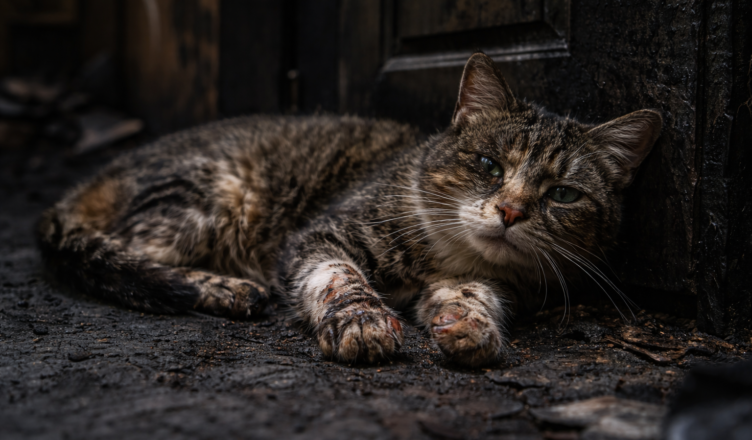
The fire was already out when they heard him.
A thin sound, barely there. Not a cry — more like a breath that didn’t know how to become one.
They found the cat in the back hallway, pressed against a door that led nowhere anymore. The paint around the frame was blistered black. The floor smelled like smoke and melted plastic. His paws were burned raw, pads split and pink, claws worn down from scratching at wood that never opened.
He had been trying to get out.
His fur was singed short along one side, whiskers curled into fragile spirals. One eye was sealed shut with swelling, the other clouded and dull. When the firefighter knelt, the cat didn’t run.
He couldn’t.
His chest hitched in shallow, uneven pulls, each breath a negotiation. Smoke had done its quiet damage — the kind you don’t see until it’s too late. Still, his head stayed lifted, chin trembling, as if he believed the door might change its mind.
They wrapped him in a clean towel.
For a moment, his claws caught in the fabric. Reflex. Then they loosened, slipping free without resistance. He tucked his face into the warmth, a sound leaving him that might once have been a purr.
At the clinic, the room went quiet.
Burns. Inhalation injury. Organ stress. The words stacked gently, carefully, like they were afraid of falling too hard. They could try — oxygen, fluids, pain relief — but the odds were thin. Even survival would mean a body that hurt every time it remembered what breathing used to be.
The vet knelt beside him.
“You waited,” she whispered. “You waited for help.”
The cat shifted weakly, pressing his head into her palm. His remaining eye closed halfway. For the first time since the fire, his breathing slowed — not because it was easier, but because he no longer had to do it alone.
They made the choice that hurts the most because it’s kind.
When it was over, his paws were still scarred with soot. The door he’d scratched was gone now, reduced to ash and memory.
But he didn’t leave the world the way he almost had — trapped, burning, unheard.
He left it warm.
Held.
And finally, allowed to rest.