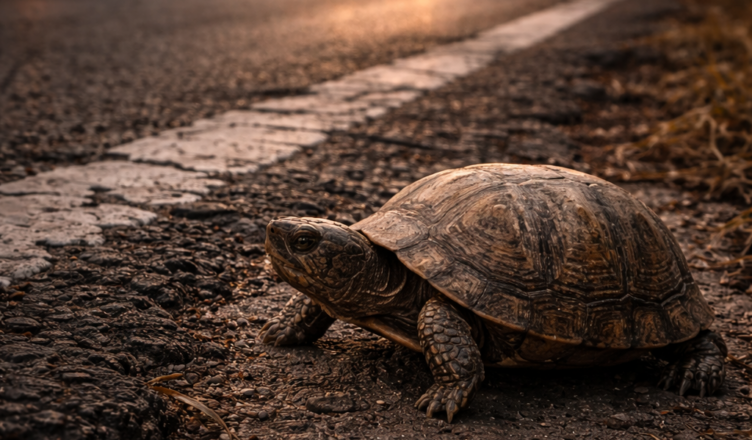
Most people never noticed him.
He was just another dark shape on the side of a long, busy highway—one more piece of debris among crushed cans and torn tires. Cars thundered past at full speed, shaking the ground beneath him. Wind whipped over his shell.
And still, the old box turtle kept moving.
Slowly.
Painfully.
Determined.
A Journey No One Understood
To drivers, he was invisible.
To him, the highway was a mountain range, endless and terrifying. He had started crossing at dawn, drawn by instinct older than roads, older than engines, older than cities.
On the other side of the asphalt was a small wetland where turtles laid their eggs every spring.
He didn’t know the world had changed.
He only knew he had to get there.
The One Car That Stopped
Marina was late for work when she saw him.
At first she thought he was a rock. Then she saw the tiny legs straining forward, the worn shell scraped and cracked, the head pulled in tight every time a truck roared by.
She pulled over without thinking.
Cars honked.
People shouted.
“Just leave it!” someone yelled from a passing window.
But Marina knelt on the hot pavement anyway.
The turtle didn’t hide. He simply kept trying to walk, as if nothing in the world mattered except reaching the other side.
That was when she saw the damage.
One back leg was injured, likely from being clipped by a tire. His shell had a long fracture running across it, raw and dirty. He had been crossing this highway for hours, maybe days.
And he was losing.
A Fragile Kind of Hope
The wildlife center took him in immediately.
They cleaned his wounds, repaired his shell with tiny braces, treated the infection that had already begun. The vet estimated he was at least forty years old.
Forty years of making the same journey.
“He’s tough,” the technician said. “But he’s tired.”
Marina visited whenever she could. She learned that turtles heal slowly. Very slowly. Weeks turned into months. The cracked shell fused little by little, like a puzzle being put back together.
He was given a name: Atlas.
Because he carried a heavy world on his back.
The Long Way Home
When Atlas was finally strong enough, they didn’t take him back to the highway.
They took him past it.
Volunteers carried him to the quiet wetland he had been trying to reach all along. Tall grass swayed. Water glimmered in the sun. Frogs sang in the reeds.
Marina set him down at the edge.
For a moment, he didn’t move.
Then he stretched out his wrinkled neck, lifted one slow foot, and began to walk again—this time on soft earth instead of burning asphalt.
No horns.
No tires.
No danger.
Just the place he had been heading to all his life.
Some rescues are loud and dramatic.
And some are simply stopping long enough
to notice something small
trying very hard not to disappear.